
Choosing between WordPress or custom development is sometimes the determinant factor when designing a modern website. Both choices fulfill different needs and are included in the broader category of website development. While WordPress is commended for its speed, affordability, and ease of use, custom development is prized for its flexibility, scalability, and semipermanent control. Making a knowing choice that supports project objectives is made easier when one is knowledgeable of their distinctions. To assist you in selecting the best course of action for your website development journey, we have compared the two ways side by side in this post based on cost, scalability, security , time to launch, design, and maintenance.
Before making a final choice, this article is designed to help readers assess WordPress and custom development from every direct viewpoint. Whether you are a developer, marketer, or business owner, the following sections provide clear explanations and practical applications for each of the following factors: cost, security, scalability, performance, and long-term sustainability. By evaluating these comparisons one topic at a time, you can discover which solution corresponds best with your theoretical requirements, budget, and growth objectives. Use this article as a guide because it outlines the advantages of each approach as well as the drawbacks that must be taken into account in the challenging digital environment of today.
Table of Contents
What is WordPress and Custom Development?
WordPress is a content management system that tons of people use to run their websites. Even if you’re not a tech expert, you can still make a site using themes and plugins. WordPress lets you put together good-looking websites fast, since there are loads of free and paid templates to pick from. People often use it for blogs, small business sites, and online stores. It’s a popular choice for making websites due to its flexibility and how easy it is to set up. This is especially true if you want something simple, affordable, and quick to launch.
Developing a website from scratch with programming languages like PHP, HTML, CSS, JavaScript etc, is called custom web development. Because everything from the features to the look is coded only for that project, it’s not like using something such as WordPress. There are no themes or plugins for you to use out of the box. This gives you full creative freedom, tremendous power, and the ability to make new things. Customisation will often be applied to such major projects as corporate solutions or platforms with lots of setup. You get a website that’s customised to the business’s exact needs, but it also likely takes longer and costs more.
Cost Comparison: WordPress vs. Custom Development
A WordPress-based site is pretty cheap to set up.“ There are plenty of free themes and plugins available, and the basic program is also free. While paid themes and premium plugins can add more functionality, prices are still reasonable. However much the costs may increase for hosting, domain names and occasional professional services, WordPress remains affordable even to smaller businesses. That being said, regular updates, plugin renewals, and possible security add-ons could make these costs creep up over time. WordPress can be a great starting point for those looking to build a website on a budget.
Basic design is expensive as from scratch everything has to be made. Professional developers need to design, develop and test features for their own needs which adds to the investment compared to implementing a CMS such as WordPress. But over time that investment often pays off. There are lower ongoing costs with custom websites, since they don’t have to depend on third-party plugins or pre-made themes. Also, they are scalable and do not have to be redesigned in the long term. As time goes on, custom development is far more cost-effective for companies who see the future value in their website as a strategic asset.
Security in WordPress vs. Custom Development
Because WordPress is one of the most popular platforms, it becomes an easy target for hackers. Vulnerable themes Bad coding, outdated themes, and under-updated plugins are one of the sources of vulnerabilities. They may enhance security as well but require ongoing maintenance—by you or your page designer. While WordPress security is manageable when the right procedures are followed, there are still worries given how commonly used the platform is. WordPress is secure enough for smaller website construction projects, but it may not be compliant with tough security measures for industries such as healthcare or finance which process sensitive information.
Developers can reduce these commonly exploited flaws by building security directly into app code in the form of custom development. It’s not like WordPress where thousands of websites exist with the same template and one exploit works for all. Advanced protocols, secure databases and encryption can be used as well by developers, as per their project demands. While no site is infallible, those that are custom built usually have stronger security. Alongside your cost savings, there is a reduced risk of common available vulnerabilities, and ensures that the creation of website is consistent with industry compliance standards for enterprises where data security is paramount.
Scalability and Performance Differences
For small to mid-size websites, WordPress is great but under the weight of complexity and traffic it can get bogged down. If you are not careful, too many plugins can strain your server and reduce load times. Perhaps that can be improved with some optimization like caching, running it through CDNs or managed hosting, but they require monitoring. Scalability in WordPress is possible, but not infinite. It’s best suited for companies expecting only gradual growth and who would like to grow into their websites incrementally, instead of biting off a full redesign at the outset.
Customised Websites are more scalable due to their nature. They’re built by developers, thinking about performance and scalability, using clean code and optimised databases. Custom programming builds in all sorts of functionality directly into the code, whereas WordPress relies on plugins to provide additional functionality. Serving the site this way ensures it can handle all that traffic as well as big data and complicated interactions with users, without jettisoning speed. Bespoke development ensures that the website remains fast as needs increase on projects of a larger scale, where scalability is essential. Good choice for long-term, growth-driven website development projects!
Time required to Build and Launch
WordPress is famed for its ease of rapid installation. A live website can often be up and running in only a few days or weeks using ready-made themes and plugins. That makes it great for businesses or individuals who need an immediate web presence. But thereby, personalisation is holding back the deployment speed. When requirements are more specific, it also takes longer to tweak themes or add plugins. While it may not provide the level of flexibility or customisation code-level access is good for, WordPress is arguably the best tool to use if you want to get a site up and running in a very short space of time.
Developing Custom is slower as each brick has to be built independently. Pre-launch, the stages will range through planning, designing, coding, testing and then be launched accordingly. (New features may take several months to develop, depending on the level of effort.) While that’s a much more time-consuming process than WordPress, the final result is an entirely custom website that fully complies with certain specifications. Question: Custom development ensures a stronger foundation for businesses that value long-term accuracy over short-term results. Quality and Goal-Aligned. This way of building websites is quality-focused and goal-aligned, so it’s perfect for those who are willing to do the hard work in the beginning, knowing that it will pay big dividends down the road.
Design Flexibility and Creativity
Websites can look professional fast, thanks to WordPress’s thousands of themes. It limits flexibility even as it opens up design. After the theme architecture, customizing it requires you to be either a developer or for you to get some help outside of the site. When there’s this dogma of using only hardware and no plugins that does restrict the sound you’re hearing. WordPress - For those who are fine with limited designs in a templated system. It may seem limiting when you are building a website that requires complete creative control.
Custom development allows for complete design control. Every element, from the design to smallest visual detail, can be customized in order to fit with the project’s goals and brand identity. Because no two sites will look or function the same, this approach ensures you are creating something unique. For companies seeking something unique—and powerful user experiences—the best option is custom development. It allows creativity without the structure of a template. This nimbleness in Web creation allows companies to stand out in a crowded market, where design can make or break a site’s ability to attract and retain users.
Maintenance and Ongoing Support
The core software, plugins, and themes of WordPress websites require regular upgrades. Although they often result in plugin conflicts, these updates enhance functionality and security. Although users may easily do maintenance, consistency is crucial to reducing risks. For minor projects, this sort of upkeep is possible. Long-term website development may be constrained by the time and effort needed for upkeep, especially for large websites with several plugins.
Although they need smaller variations, custom- erected websites constantly bear professional support from inventors who are knowledgeable with the coding. Stability is easy to maintain because there are n’t any general plugins or themes. Because of unique development, updates are precisely considered and tested before being put into effect. The outgrowth is a more durable platform with smaller dislocations, despite the threat that continual support will be more specialized. Custom results in website development give a solid frame for enterprises who value effectiveness and continuity over short- term, plugin- grounded results.
Key differences between WordPress and Custom Development
WordPress and custom development are worlds apart in flexibility and simplicity. WordPress is perfect if you’re not super techy. It has themes, plugins, and stuff that makes creating sites quick and affordable. Custom development, though, is built from the ground up, so you can do pretty much anything. This means a totally unique design and features that fit your exact needs. WordPress is great if you want to launch your site ASAP, but custom development is the better option for a unique brand and big growth plans. Really, it boils down to speed versus total control.
| Feature | WordPress | Custom Development |
| Usability | Easy for beginners to use with drag-and-drop. | Requires technical knowledge of coding. |
| Cost | Lower starting price. | Higher initial outlay of funds. |
| Customization | Restricted by plugins and themes. | Completely adaptable and customized. |
| Deployment Speed | Quick, launch-ready. | Slower, custom-built. |
| Scalability | Limited scalability for extremely big projects. | Extremely scalable for complex requirements. |
| Maintenance | Updates for plugins and themes are necessary. | Needs committed developer assistance. |
| Security | Dependent on Updates and Plugins | More powerful, with specially designed security. |
WordPress vs Custom Dev. (SEO features)
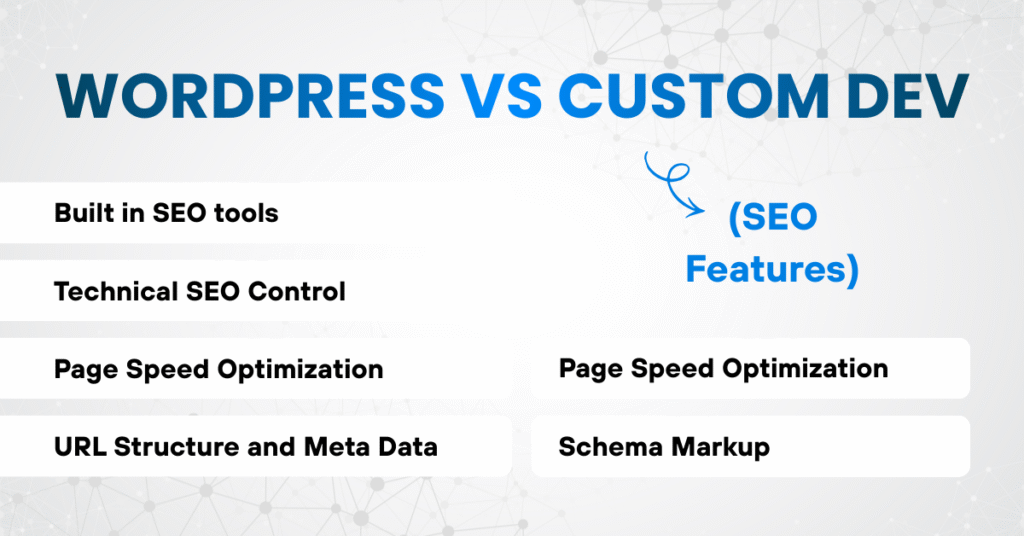
1. Built in SEO tools
WordPress stands out for its made in SEO benefits, thanks to tools like Yoast, RankMath, and AIOSEO. These tools streamline essential optimization tasks similar as adding meta markers, managing keywords, creating sitemaps, and perfecting content readability. Indeed individualities with nethermost SEO knowledge can successfully enhance their runners. In discrepancy, custom development doesn’t come with anypre-installed SEO features, taking all rudiments from metadata fields to sitemap creation to be programmed from the ground up. While this requires fresh trouble, it allows inventors to produce a system that’s specifically customized to meet the SEO requirements of a design without counting on third party plugins.
2. Technical SEO Control
Technical SEO on WordPress is sometimes limited by theme architecture, plugin compatibility, and platform restrictions. Innovative controls such as crawl directives, custom indexing rules, and performance tweaks may require additional coding or specialised plugins. With custom development, theoretical SEO is built directly into the structure of the website. Developers can fine tune crawling behaviour, improve database efficiency, manage server level performance , and structure pages for ideal search locomotive visibility. This level of control makes custom websites better suited for businesses with complex SEO requirements.
3. Page Speed Optimization
For a website to rank well online, page speed is crucial. The theme you choose, the size of your plugins, and the hosting location all affect how quickly your WordPress website loads. If you load up on too many plugins or intricate page builders, your site can get slow, and it damages your Core Web Vitals. However, creating a website from the beginning up might be far quicker. Since the code is clean and simple, developers may change how images are handled, set up caching, manage resources, and set up the server right from the start. The outcome is a site that loads incredibly fast and keeps visitors pleased.
4. URL Structure and Meta Data
WordPress lets you handle metadata and URL setups with plugins, but you’re still stuck with how WordPress does permalinks. How flexible you can be really depends on what the plugin can do, and some fancy URL setups might be impossible. If you code your own thing, you get total control to create great URL formats and metadata systems that fit your SEO plans. You can make well-organized, clear URLs with keywords and use metadata rules that perfectly mirror how your site is structured.
5. Schema Markup
Schema markup helps search engines understand content better, and WordPress offers schema support through plugins. However, these plugins normally follow standard patterns, limiting customization for complex websites. Custom development enables developers to write schema markup directly into the code, offering right control over structured data . Whether it’s product schema, FAQs, breadcrumbs, or custom schemas for unique content types, custom built websites can deliver richer , more true structured data that enhances search visibility and improves click through rates.
6. Floating SEO
Floating SEO on WordPress mostly depends on how well the chosen theme is optimised for floating responsiveness. Many themes are responsive, but some rely heavily on CSS frameworks or page builders, which can slow performance or create layout issues on floating devices. Custom development takes a floating first approach, ensuring that the website is optimised for all screen sizes from the ground up. Developers can build adaptive layouts, optimize touch interactions, and streamline floating loading, resulting in a smoother experience and stronger floating SEO performance.
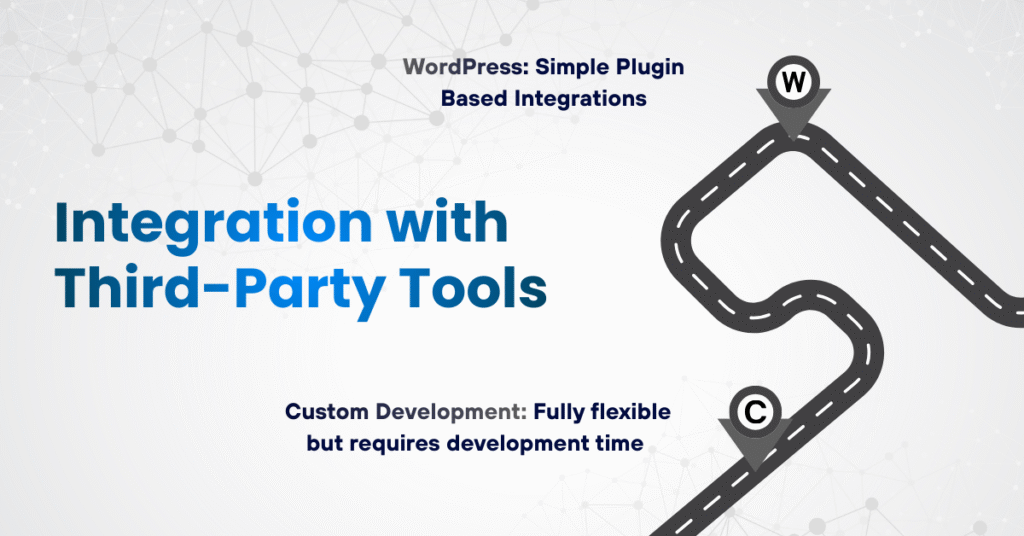
Integration with Third-Party Tools
1.WordPress: Simple Plugin Based Integrations
WordPress makes third-party integration incredibly easy with its vast library of plugins. Whether a business needs CRM connectivity, payment gateways, email marketing tools, or automation platforms, near solutions are accessible as ready-to-install plugins with minimal setup. General CRMs like HubSpot and Salesforce can be connected immediately using formal or third-party plugins. Payment systems such as Stripe, PayPal integrate without custom coding. This plug-and-play approach saves time, reduces development cost, and makes ongoing management easier for business owners, even if they have limited technical knowledge.
2.Custom Development: Fully flexible but requires development time
still, you can do whatever you want when you add CRMs, ERPs, if you make a website from scratch. Since it’s all custom-enciphered, you get to produce workflows, data flows, and system tests exactly how you want them. WordPress plugins can not always do that. This kind of customization is great if you have systems that all need to work together. Just keep in mind that every integration takes time to make, test, and keep running. Custom development gives you tons of flexibility and lets you scale later, but it’s more precious and takes longer to get up and running.
Which platform fits your Business? Practical use case examples
1. Portfolio Websites
WordPress is ideal for portfolio websites . Even if you don’t have technical expertise, you can quickly develop visually stunning websites and easily maintain your content. There are several themes accessible for you to pick from, with user friendly drag and drop capabilities and essential plugins. Therefore, whether you’re a photographer, designer , writer, or other type of creative, it functions flawlessly. It’s affordable and uncomplicated , renting you to concentrate on showing your work rather than dealing with intricate coding.
2. E-Commerce website Best fit depends on scale
WordPress is consummate for portfolio websites. Even if you don’t have technical expertise, you can quickly develop visually stunning websites and easily maintain your content. There are several themes accessible for you to pick from, with user friendly drag and drop capabilities and essential plugins. Therefore, whether you’re a photographer, designer, writer, or other type of creative, it functions flawlessly. It’s affordable and uncomplicated, renting you to concentrate on showing your work rather than dealing with intricate coding.
3. Enterprise Dashboard: Best fit Custom Development
Enterprise dashboards involve managing confidential information, intricate processes, advanced automation, and extensive connections with internal systems. These demands exceed what WordPress can consistently handle. Tailored development provides the structure, protection, and adaptability essential for creating dashboards that seamlessly integrate with a company’s internal workflows. It enables companies to develop tools that expand alongside increasing data and operational requirements, rendering custom solutions the perfect option for enterprise-level applications.
4. Real-Estate Portals Best fit: Custom Development
Real-estate platforms typically require features such as property listings, dynamic search filters, geo-location mapping, agent dashboards, CRM integration, and automated lead management. While WordPress can handle basic listing websites, advanced portals need a fully customized backend to manage high traffic, real-time property updates, and unique business logic. Custom development provides the power and flexibility required to build a reliable, scalable real-estate ecosystem that supports long-term growth.
Which one should you select?
WordPress is a great pick for showing off your work, running a small biz, blogging, or selling a few things online. It’s cheap and easy to use, plus it can do most things a normal site needs. If you want to get online fast without spending a ton, WordPress is a good way to go. It’s also super if you want to build a basic website and don’t know much about tech.
WordPress and custom development each have their own advantages, depending on what you need, how much money you have, and how quickly you need it done. WordPress works great for smaller projects since it’s fast, cheap, and easy to pick up. But, if you’re working on a big, complicated website, custom development might be the way to go because it can grow with you, bend to your needs, and last a long time. To pick the right one, think about what you need now and what you’ll need later. Both are valuable ways to build a website, but picking the right path helps make sure you get better results, happier users, and stay successful for the long haul.
FAQ’s
1 Is WordPress secure enough for business websites?
Yes, if you take care of it. Keeping WordPress secure means doing some necessary things: updating regularly, using powerful passwords, getting good hosting, and only using authentic plugins and themes. Lots of businesses and even government sites use WordPress safely because they take these steps. Since it’s open source, it can be risky if you don’t manage it well. For erogenous info, add extra defences like firewalls, SSL certificates, and orderly backups. If top-level security is needed, a custom-built website might be better. You can program security methods to fit precisely what the business needs, giving you more control and safety. But overall, WordPress is normally dependable if you handle it right.
2 Is WordPress dependable enough for business websites?.
Yes, WordPress can be extremely dependable if you handle it correctly. It’s pivotal to keep it up to date, use strong passwords, have reliable hosting, and only use plugins and themes you trust. Many companies and even government websites utilise WordPress firmly by following a few easy steps. Since it’s open source, it can be harmful if you don’t watch it. Extra safety steps like firewalls, SSL certificates, and orderly backups are pivotal if you’re dealing with sensitive info or critical websites. If you need crazy high security, you may design a custom website where security is coded expressly for what your firm needs. It gives you more control and safety than WordPress, even if WordPress is broadly fine.
3 So, which is better for growing over time?.
Usually, custom development wins out for semipermanent growth. It lets your website grow right along with your business. WordPress can handle some growth with plugins and tweaks, but if you get a lot of traffic or complex stuff going on, you might see some slowdowns. On the other hand, custom sites are built exactly how you need them. This lets developers fine-tune the database, how well it runs, and all the behind-the-scenes stuff. This makes scaling up easier and further dependable later on. If you’re expecting to grow fast, going custom is often the smarter move for the future.
Conclusion
If you have a business or startup with a totally new idea or a system that does a lot, custom development might be the way to go. Custom websites are more flexible than WordPress, especially if you are worried about growth, security, and working with complicated systems. They also let you create unique experiences for your users, which can help you stand out from the crowd. If you see your website as something you’ll be using for a long period, custom development can make sure it stays flexible and up-to-date, even when things change.