

Cloud computing has become the backbone of modern businesses, and Amazon Web Services (AWS) is one of the biggest reasons behind this shift. AWS offers a huge range of tools that help companies build apps faster, store data safely, manage networks, and scale their systems without worrying about physical hardware. It might be challenging to know where to begin with the wide range of services available, especially for beginners or those getting ready for AWS certification tests. To make things easier, this guide highlights the Top 10 AWS Services that every professional, student, and cloud learner should be aware of. The services cover the essentials of computing, storage, security, networking, automation, monitoring, and application deployment. Learning them builds a strong foundation and helps anyone get comfortable with real-world cloud projects. Whether you’re aiming for a career in cloud computing or simply exploring how AWS works, these services will give you a solid start and clear direction.
Along with simplifying cloud adoption, these AWS services also help businesses improve reliability, automate operations, and reduce long term costs. Many companies use them because AWS offers global data centers, powerful security features, and varied pricing options appropriate for all sizes—startups to enterprises—many businesses employ them. The platform also integrates seamlessly with IoT, DevOps, AI, and analytics tools, making it simpler to create cutting-edge, scalable applications. Understanding these fundamental AWS services becomes even more important as industries continue to shift toward digital transformation.
Table of Contents
What is AWS?
AWS (Amazon Web Services) is a cloud computing platform offered by Amazon. It provides a wide range of services, including computing power, networking, databases, storage, security, and more over the internet. Instead of buying physical servers or hardware, companies can run AWS to run applications, store data, and manage their IT systems easily at lower costs. AWS works on a pay-as-you-go model, which means payment is only for the services used. It also offers global infrastructure with data centres across many regions, ensuring high speed, reliability and security. Today, AWS is used by enterprise-level projects, government organisations, and individuals for tasks such as website hosting, mobile app backend, machine learning, and data analytics. It is one of the most widely used cloud platforms because of its ease of use, scalability, security, and hundreds of services readily accessible for multiple uses.
Top 10 AWS Services
Although Amazon Web Services offers a huge range of cloud tools, there are a few services that all beginners, experts, and certification candidates must understand clearly. These core AWS services make it possible to run applications, data storage, database management, secure access, content delivery, performance monitoring, and automatically scale resources as demand changes. They form the backbone for most cloud solutions and are used by businesses of all sizes, from startups to multinational corporations. They form the backbone for most of cloud solutions and are used by businesses of all sizes, from startups to multinational corporations. whether the goal is to create reliable web application, move an existing system to the cloud, or prepare for AWS certification examinations. Knowing these top services offers a strong basis The following list covers the 10 most important and widely used AWS services that play a crucial role in real-world cloud architecture and day-to-day cloud operations
1. Amazon EC2 (Elastic Compute Cloud)
Amazon EC2 provides cloud-based virtual machines that function similarly to physical computers. Different instance types can be selected based on CPU, memory, and storage needs. It supports both Windows and Linux operating systems. Resources can be scaled up or down depending on the volume of traffic levels. EC2 works with load balancers to handle heavy website or application loads. Extra storage can be attached using EBS volumes. Security groups help control incoming and outgoing traffic. Auto Scaling can automatically manage resources during peak times. EC2 is commonly used for hosting websites, Applications, and processing workloads. It is one of the key services in AWS exams. Amazon EC2 also offers placement groups, which help optimise performance for high-compute or low-latency workloads.
It supports Spot instances, allowing unused AWS capacity to be purchased at significantly lower prices for cost-efficient operations. For companies that require hardware isolation for compliance, EC2 offers dedicated hosts. It integrates with AWS Systems Manager to simplify patching, automation, and server maintenance. Networking performance can be enhanced with Elastic Network Adapters (ENA) and advanced bandwidth options. EC2 works closely with CloudTrail and AWS Backup to ensure better data protection and activity tracking.
2. Amazon S3 (Simple Storage Service)
Amazon S3 is a simple and secure storage service for saving any amount. All data is stored in containers called buckets. It offers extremely high durability, making it suitable for long-term storage and backups. Multiple storage classes are available based on cost and access patterns. S3 supports Versioning, replication, and lifecycle rules. It is used widely to store application data, documents, logs, and media files. Access can be managed through IAM, and bucket policies are two methods for controlling access. S3 works well with CloudFront for faster content delivery. Events in S3 can trigger other services, such as Lambda. Its simplicity makes it one of the most popularly used AWS services.
To protect stored files, Amazon S3 also offers effective encryption solutions, such as server-side and client-side encryption. It integrates smoothly with big data tools like Amazon Athena and Amazon Redshift for data analysis directly from buckets. S3 provides Pre-signed URLs from S3 provide secure, short-term access to particular files without revealing complete permissions. It offers cross-region replication to keep data synchronised across multiple regions for disaster recovery.
associate-cloud-engineer-certification-exam
3. Amazon RDS (Relational Database Service)
Amazon RDS, Amazon RDS, is a managed service that makes it easy to set up and maintain relational databases. It supports MySQL, PostgreSQL, SQL Server, MariaDB, and Oracle. Updates, patching, and backups are handled automatically. Multi-AZ deployment provides high availability during failures. Storage and Compute resources can be increased as applications grow. Read replicas improve performance for read-heavy workloads. Databases can be secured inside a VPC. Permissions are managed using IAM and security groups. Monitoring is available through CloudWatch and Performance Insights. RDS reduces the burden of database management and is frequently used in AWS Certification topics.
Amazon RDS, also supports automated snapshots and point-in-time recovery, allowing databases to be restored to any previous moment. It integrates well with AWS Database Migration Service (DMS), making it easier to move data from on-premise systems or other cloud databases. RDS offers storage autoscaling. which increases disk capacity automatically when usage grows. It provides enhanced security using encryption at rest and in transit, powered by AWS KMS.Customizable parameter groups provide additional control over database settings and can increase performance. By controlling connection pools for applications with erratic or heavy traffic loads, RDS Proxy further increases efficiency.
Also Read top-10-cloud-security-tools-for-protecting-cloud-environments
4. AWS Lambda
AWS Lambda allows code execution without managing any servers. Code runs automatically when events occur. It supports several programming languages such as Python, Java, and Node.js. Lambda scales automatically whenever event volume increases. Billing is based only on the time code runs, helping reduce cost. It integrates with over 200 AWS services, such as API Gateway, DynamoDB, and S3. Lambda fits well in automation and microservices-based systems. Environment variables are used for Configuration. Logs and monitoring go through CloudWatch.
It is a core part of serverless computing and highly relevant for AWS Certifications. AWS Lambda supports Concurrency controls that let teams manage how many functions run at the same time, helping balance performance and cost. It offers provisioned concurrency for apps that need instant response without cold starts. Lambda functions can securely access databases and internal systems by connecting to private networks via VPC integration. The service also provides asynchronous event processing with built-in retry behaviour to handle failures smoothly. Lambda Layers allow sharing common code, libraries, and dependencies across multiple functions.
5. Amazon VPC (Virtual Private Cloud)
Amazon VPC creates a private and isolated network within AWS. Routing rules, IP ranges, and subnets can be designed based on the needs of the application. Private subnets host secure internal services, whereas public subnets host internet facing resources . Network ACLs and security groups are used to govern traffic. Traffic control is managed through security groups and network ACLs. VPC supports VPN and direct connect for hybrid cloud setups. NAT gateways allow private servers to access the internet safely. Flow Logs help monitor and analyse network traffic. VPC ensures a secure and organised network structure for cloud applications. It forms the base of almost every AWS environment. VPC knowledge is essential for architecture and networking exams.
Amazon VPC also supports advanced network segmentation through features like Transit Gateway, which helps the large-scale connection of numerous VPCs and on-premise networks. VPC Peering allows communication between VPCs across Regions without needing VPNs. For improved security, Gateway Endpoints let services like S3 and DynamoDB be accessed privately without using the public internet.
6. Amazon CloudFront
Amazon CloudFront is a worldwide network for content delivery that speeds up the delivery of websites and content. A global network of content that speeds up the delivery of websites and content. It uses edge locations worldwide to reduce latency. CloudFront caches data nearer to end users for faster access. It can be used to deliver both dynamic and static material. CloudFront integrates with S3 and API Gateway, and custom servers. Security is improved through AWS Shield, WAF, and SSL/TLS encryption. Access can be restricted using URLs and other controls. It is commonly used for video streaming websites and API acceleration. Real-time monitoring is provided through CloudWatch. CloudFront plays an important role in global performance optimisation.
CloudFront supports customizable cache behaviours, allowing different rules for various URL paths and content types. It offers origin failover, which automatically switches to a backup origin if the primary one becomes unavailable, ensuring uninterrupted delivery. Signed cookies can be used alongside signed URLs to secure private content distributed across multiple files. CloudFront supports HTTP/2 and HTTP/3, which lowers load times and increases connection efficiency. Because of its integration with Lambda@Edge, developers can execute custom code at edge locations for tasks like user authentication or header manipulation. Depending on the country of the viewer, geo-blocking can be set to either permit or prohibit material access. Additionally, CloudFront offers comprehensive cache data for hit ratio analysis and delivery strategy optimisation.
top-8-cloud-computing-skills-to-master
7. AWS IAM (Identity and Access Management)
AWS IAM is used to manage who can access what in your AWS account. To assign permissions, you can create roles, groups, and users. Policies that specify what can be done are written with permissions. MFA is supported by IAM to protect accounts. Without keeping passwords, roles are used to grant short-term access to AWS services. IAM also supports SSO and external identity providers. It helps enforce the principle of least privilege. IAM works with AWS Organisation for account-wide controls. Access analyser helps find risky permissions. IAM is a core security tool for all AWS users and exams.
AWS IAM also supports permission boundaries, which help specify the maximum level of access a user or role can ever receive. In large organisations, Service Control Policies (SCPs) can be used to limit actions across several accounts. Through CloudTrail, IAM offers full access to records that make it easier to keep track of who did what. Additionally, it enables resource-based policies, which enable permissions to be directly linked to AWS resources such as Lambda functions or S3 buckets. AWS STS can provide temporary credentials for safe, brief access.
8. AWS Elastic Beanstalk
AWS Elastic Beanstalk AWS Elastic Beanstalk helps rapid deployment of applications without managing infrastructure. It supports many programming languages, including PHP, Python, and Java and more. Beanstalk handles servers, networks, and scaling as you upload your code. It automatically monitors the environment and restarts unhealthy instances. You can customize settings using Configuration files. It provides metrics and logs for CloudWatch. Beanstalk can connect with VPC, RDS, and IAM for secure deployments. It supports blue/green deployments to avoid downtime during upgrades. It is ideal for beginners who want easy deployment, Beanstalk makes managing cloud applications easier.
9. Amazon CloudWatch
Amazon CloudWatch is a monitoring service for AWS resources and applications. It collects events, logs, and analytics in real time. You can set alarms to get notifications when something goes wrong. You can set alarms to get notifications when something goes wrong. CloudWatch Logs store and analyse log files from EC2, Lambda, and other services. CloudWatch Events (EventBridge) helps automate tasks based on system changes. Dashboard allows you to monitor performance visually. CloudWatch integrates with autoscaling to adjust resources automatically. Contributor insights help find traffic patterns. It is useful for troubleshooting and optimisation. CloudWatch is essential for keeping applications healthy and stable.
10. AWS Auto Scaling
AWS Auto Scaling automatically adjusts your computer resources based on demand. It watches metrics such as CPU use and request count. When traffic decreases, it removes extra instances to save money. Auto Scaling groups help manage servers across multiple availability Zones. You can set rules and policies to control scaling behaviour. It integrates with CloudWatch, ELB and EC2. Auto Scaling improves application availability and performance. It is widely used for building flexible and scalable cloud systems.
AWS Auto Scaling also supports predictive scaling, which uses machine learning to predict future traffic and adjust capacity before demand rises. It can manage scaling for multiple AWS services at once, including such as DynamoDB, ECS, and Aurora. Depending on workload patterns, auto scaling strategies can be set up utilizing target tracking, step scaling, or planned scaling. It extends scaling beyond EC2-based systems by closely collaborating with AWS Application Auto Scaling. Even in the event of unforeseen traffic spikes, auto scaling ensures constant application performance. In order to help improve strategies over the years, the service also offers comprehensive scaling histories and insights.
How to choose the Right AWS Services

How to choose the Right AWS Services
| How to choose the Right AWS Services | Best AWS Services | Why this Service fits |
| 1. Run Applications or Servers | Amazon EC2 | Provides virtual Machines with full control over compute power |
| 2. Run Code without managing Servers | AWS Lambda | Serverless, and auto-scaling, Event-driven Execution, low-cost |
| 3. Deploy Applications easily | AWS Elastic Beanstalk | Scaling and monitoring automatically |
| 4. Store files, images videos or backups | Amazon S3 | Scalable and highly durable storage |
| 5. Store relational database data | Amazon RDS | Managed database with automated backups and high availability |
| 6. StoreNo SQL database data | Amazon DynamoDB | Fast Scalable, fully managed NoSQL database services. |
| 7. Create a Private and Secure Network | Amazon VPC | Offers complete control over Cloud Networking. |
| 8. Deliver content quickly worldwide | Amazon CloudFront | Global CDN with low latency and caching |
| 9. Monitor Applications and resources | Amazon CloudWatch | Provide metrics, logs and alerts for performance tracking |
| 10. Control access and security | AWS IAM | Manages users, roles, and permissions for all AWS resources |
Benefits of using AWS Services
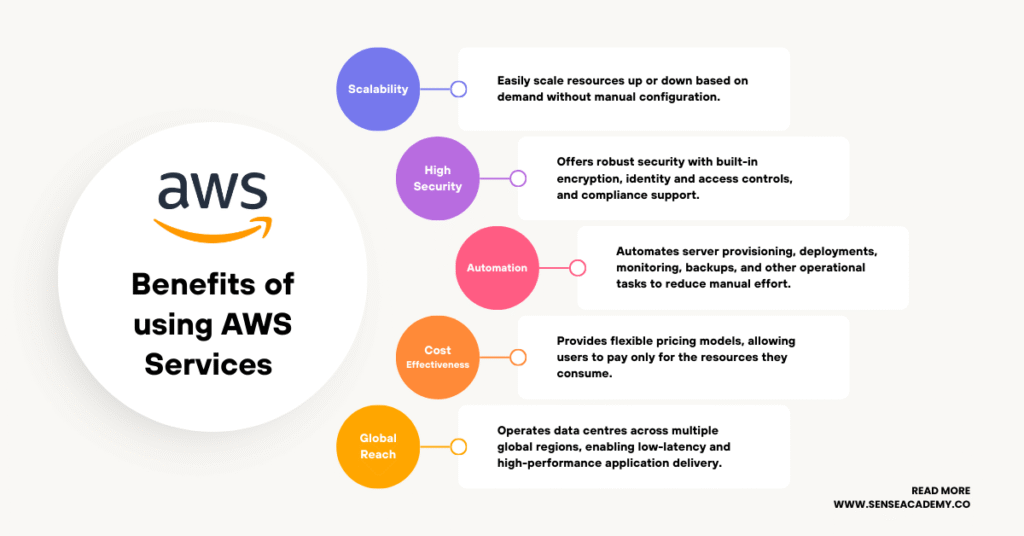
AWS offers several strong advantages that make it one of the most trusted cloud platforms. One major benefit is scalability, which allows businesses to increase or decrease resources based on demand without any manual setup. AWS also provides high-level security with built-in encryption, identity controls, and compliance support, helping organisations protect their application and data. Another key advantage is automation. AWS tools can automatically manage tasks such as server provisioning, backups, monitoring, and deployment, reducing manual work and errors. It is also known for cost efficiency, because customers pay only for the resources they use, and can choose from multiple pricing models to optimise costs. Finally, AWS has a global reach, offering data centres across many regions worldwide. This allows applications to run closer to end users, reducing latency and improving performance.
Benefits of using AWS Services
- Calability: Easily increase and decrease resources based on demand.
- High Security: Integrated identity management, built-in encryption, and compliance support.
- Automation: Automates tasks such as server management, deployments, monitoring, and backups.
- Cost-effectiveness: Use flexible pricing options to only pay for what is used.
- Global Reach: Data centres around the world help deliver faster performance to users.
AWS Global infrastructure
AWS Global infrastructure
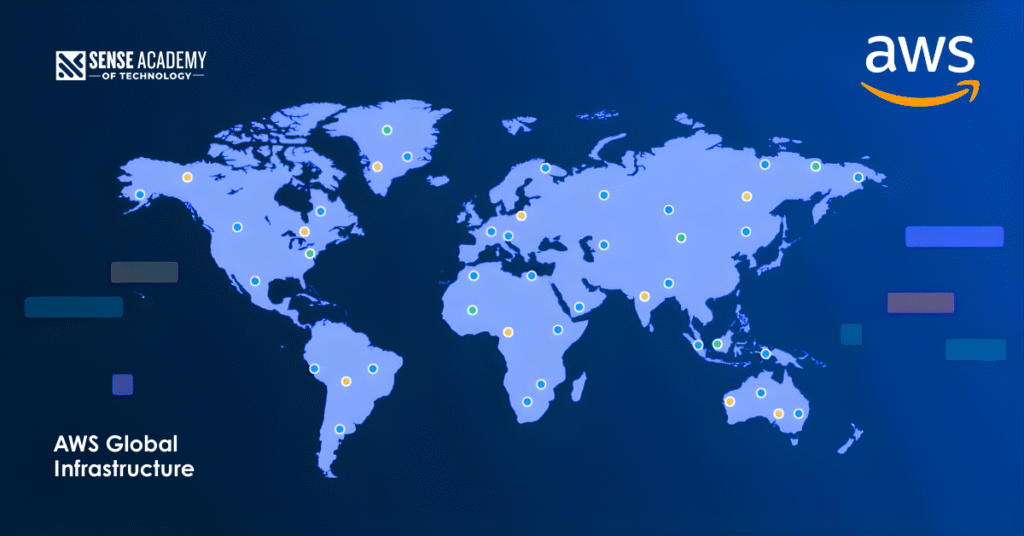
AWS Global infrastructure is the worldwide network of data centres that powers all AWS services. It is designed to keep applications fast, secure, and always available. The infrastructure is divided into Availability Zones (AZs), Edge Locations, and Regions are physical areas across the world. AZs are separate data centres inside each region, and Edge Locations help deliver content quickly through CloudFront. his structure helps reduce downtime, improve speed and support global users without performance issues. Businesses can deploy applications close to customers in any country, improving reliability and user experience.
1. AWS Regions
- AWS Regions are large geographic areas located around the world. Where AWS places its data centres.
- Each region operates independently, which helps increase reliability and data protection.
- Businesses choose a region based on factors like customer location, data laws, and performance needs.
- Having multiple regions allows applications to run closer to users, reducing delays and improving speed. It also supports disaster recovery by allowing backups in different regions.
2. Availability Zones (AZs)
- Availability Zones are separate data centers within an AWS Region.
- A failure in one AZ does not impact the others because each AZ has its own network, power, and cooling.
- Applications can be spread across multiple AZs to stay online even if one zone faces a problem.
- The setup increases reliability and ensures business continuity.
- AZs and Regions cooperate to provide strong fault tolerance and high availability.
3. Edge Locations
- Edge Locations are smaller data centers, used mainly for delivering content quickly to users.
- They are part of the content delivery network (CDN), Amazon CloudFront.
- When a user requests data, the nearest Edge Location delivers it, reducing load time and improving performance.
- There are hundreds of Edge Locations across the globe to support fast global content delivery.
- This helps websites, apps and streaming services run smoothly, even for users far from the main region.
Our course- aws-certified-devops-engineer-professional
FAQ’s
1. What is AWS, and why is it popular?
AWS, or Amazon Web Services, is a cloud platform that offers servers, storage, databases, and security solutions on demand. It is commonly used because it removes the need for physical hardware, allowing companies to scale, reduce costs, and operate faster. Another major reason for its popularity is its global presence, which helps applications run smoothly from anywhere in the world. AWS provides a vast ecosystem of services, strong security, and automation tools. For startups, businesses, and developers getting ready for cloud certifications, this combination makes it a best option.
2. Which AWS services are most important for certification exams?
Most AWS Certification exams focus on core services such as EC2, S3, IAM, VPC, LAMBDA, RDS, CloudWatch, CloudFront and Auto Scaling. These services form the foundations of AWS and appear repeatedly in exam questions related to architecture, security, networking, and cloud design. Understanding how these services work together is essential for building solutions in the cloud. Certifications also test practical concepts like deploying applications, managing permissions, and ensuring high availability.
3. How does AWS improve the performance and reliability of applications?
AWS improves the performance through its global infrastructure, which includes Regions, Availability Zones, and Edge Locations. Applications can run in multiple zones to avoid downtime if one data center fails. Edge Locations help deliver content faster to users by reducing latency. AWS also provides monitoring tools like CloudWatch and automatic scaling features that adjust resources during high or low traffic. Together, these components help applications stay fast, available and stable even when demand changes suddenly.
Conclusion
AWS has become one of the most powerful and trusted cloud platforms because of its flexibility, security and global reach. Learning its key services not only helps with certification exams but also builds a strong foundation for real-world cloud projects. From running applications and storing data to scaling resources and managing identities, AWS offers end-to-end solutions for nearly every cloud need. With proper understanding of core services like EC2, S3, IAM, VPC, lambda and more anyone can build reliable, high-performing, and cost efficient cloud environments. This knowledge prepares learners, developers and businesses to grow confidently in the world of cloud computing.