
Full-stack development offers a dynamic career scope, skills, salary and adaptable method of creating software by fusing front-end design with back-end logic. Building and managing entire web apps from start to finish has become a highly sought-after expertise in today’s rapidly changing tech market. Full-stack developers are becoming vital resources that can bridge the gap between various technological layers as businesses look for efficiency and agility in their development processes. This adaptability guarantees long-term relevance in a competitive labor market in addition to providing a variety of employment options. Anyone hoping to stay ahead in the digital age must have a solid understanding of full-stack development, including what it comprises, the skills needed, and its prospects.
Table of Contents
What is Full-Stack Development?
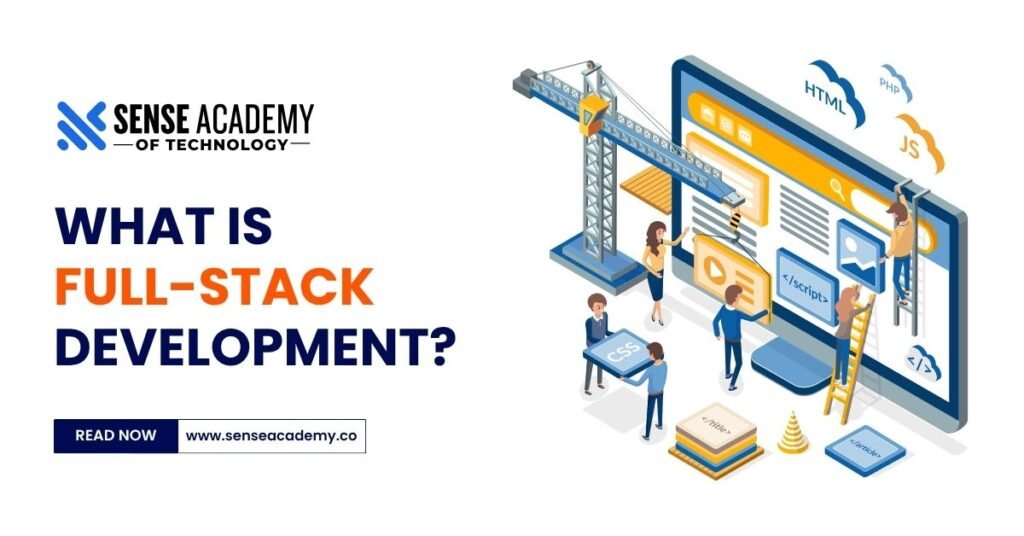
The capacity to work on both the front-end and back-end components of a web application is known as full-stack development. A full-stack developer is capable of managing both the server-side (backend logic, database interaction, and APIs) and client-side (what users interact with). By facilitating communication between various development levels, this comprehensive skill set enables developers to create entire web apps on their own or collaborate effectively in teams. The need for experts who can handle the full development process—from conception to deployment—is increasing quickly as technology stacks become more interconnected. Knowing both ends is only one aspect of full-stack development; another is comprehending how they relate to and work together in practical applications.
Essential Tools and Technologies in Demand
Gaining proficiency in both front-end and back-end technologies is essential for full-stack developers. Proficiency in HTML, CSS, JavaScript, and front-end libraries such as React, Angular, or Vue.js is crucial. Understanding frameworks and languages like Node.js, Express.js, Python with Django, or Java with Spring Boot is essential for the back end. Additionally crucial is familiarity with databases such as MySQL, MongoDB, and PostgreSQL. Building scalable and stable apps also heavily relies on tools like REST APIs, Docker, and Git. Full-stack developers may maintain their competitiveness in a profession that is changing quickly by staying up to date with new frameworks and cloud technologies.
Roles and Duties of Full-Stack Developers
Throughout the development cycle, a full-stack developer takes on a variety of roles. It includes creating and maintaining databases, designing user interfaces, producing responsive web pages, configuring server architecture, and providing APIs to link the front end and back end are among the duties. Additionally, testing, debugging, performance optimization, and making sure the application functions properly on many platforms are frequently part of this task. Full-stack engineers are highly regarded in agile teams, startups, and enterprise-level settings due to their broad skill set. They can make well-rounded decisions and make significant contributions at every stage of the software development lifecycle because of their ability to see the wider picture.
Professional Development and Industry Prospects

In light of the wide range of applications for its skill set, full-stack development provides excellent career advancement. In certain startups, positions might range from junior developer to tech lead, senior software engineer, or even CTO. Companies in a variety of sectors, including e-commerce, SaaS, healthcare, and finance, are actively looking for developers with the ability to create and manage entire systems. Startups, mid-sized businesses, and tech giants all value full-stack talent’s adaptability, particularly in settings that are focused on products. Full-stack developers frequently find themselves at the forefront of innovation because of the growing emphasis on lean development and quick prototyping. They also have plenty of opportunity to upgrade their skills and move into more technical or administrative positions.
Trends in Income and Earning Capabilities
Salary trends are directly impacted by the need for full-stack engineers. Because of their broad skill set, these professionals frequently receive more competitive pay. Entry-level pay is alluring, and after a few years of experience, earnings can increase dramatically. Full-stack engineers make more money than single-skill developers in many areas, according to numerous industry reports. Benefits like stock options, remote flexibility, and performance bonuses are common in full-stack positions in tech hotspots like Bangalore, London, San Francisco, or Berlin. Their expertise’s hybrid nature enables them to assume leadership positions early on, increasing their earning potential.
Certifications and Educational Routes

An organized learning route and the appropriate credentials make it easier to get started in full-stack programming. Using a combination of technologies, such as HTML, CSS, and JavaScript for the user interface and Python, Ruby, or Node.js to handle server-side logic and database operations, full-stack developers are capable of producing responsive, interactive, and fully functional websites. To guarantee smooth operation throughout the application stack, they also collaborate with databases, version control systems, and deployment tools. Our full-stack development curriculum at Sense Academy is meant to teach people these vital technologies while giving them practical experience and exposure to real-world projects. This equips students to deliver end-to-end solutions in fast-paced development environments.
Master Full Stack Web Development Course Explore Frontend and Backend Skills with Senseacademy
The Effects of Freelancing and Remote Work
The environment of full-stack development has changed as a result of remote labor. Full-stack engineers can now work from any location and contribute to international projects thanks to the growth of dispersed teams and cloud-based workflows. On websites like Upwork, Freelancer, and Toptal, where full-stack jobs are among the most sought-after, this change has also increased freelance prospects. Both short-term and long-term contracts, flexible scheduling, and the opportunity to select tasks that meet their area of competence are advantages for freelancers. Full-stack freelancers are preferred by employers because they eliminate the need for coordination between several developers. The profession’s charm and future security are increased by its remote-friendly nature.
Upcoming Development Trends in Full-Stack
Rapid technical breakthroughs are shaping the future of full-stack development. Developers are being forced to comprehend and create more intelligent user experiences as a result of the incorporation of AI and machine learning into applications. Modern development is increasingly reliant on cloud computing, serverless architectures, and platforms like AWS, Azure, and Google Cloud. Scalability and automation have made knowledge of DevOps procedures, CI/CD pipelines, and containerization tools like Docker and Kubernetes essential. Furthermore, full-stack positions are being redefined by the need for performance, accessibility, and user-centered design. Full-stack development is still essential to creating reliable, future-ready IT solutions as digital transformation picks up speed.
Conclusion
With the ability to work with both front-end and back-end technologies, full-stack development has become a potent and future-proof professional path in the tech sector. Long-term growth and a variety of employment options are made possible by developing full-stack abilities, as there is a growing need for experts who can create comprehensive, scalable apps. Our full-stack development program at Sense Academy is meant to give students practical exposure with contemporary stacks like MERN and MEAN, enabling them to confidently take on real-world projects from beginning to end. Full-stack development provides the resources and flexibility required to succeed in the fast-paced digital world of today, whether one is starting a new profession or improving current abilities.
Do I need to learn full-stack development, or is it better to focus on front-end or back-end?
More flexibility and career options are available with full-stack development since the tech sector is beginning to value adaptability and end-to-end product ownership. Full-stack abilities allow developers to comprehend and contribute to the whole application lifecycle, which makes them more useful in startups, freelancing projects, and agile teams, even though specialization might result in strong experience in one area. It’s usually advised to begin with one aspect (back-end or front-end) and work your way up to full-stack capabilities.
In the current digital environment, is a career in full stack development a promising one?
Of course. The need for engineers who can manage both front-end and back-end operations is rising quickly as more and more organizations rely on digital platforms. Full stack developers are extremely significant since they provide a one-stop shop for developing web applications. Their adaptability enables businesses to increase development speed, cut expenses, and streamline teams—making this a very fulfilling and future-proof job choice.
In the near future, will full-stack developers be replaced by AI?
Although they are changing the way developers write and debug code, AI tools like ChatGPT and GitHub Copilot are not taking the place of full-stack coders. Rather, by automating monotonous operations, they are increasing productivity. Human knowledge is still needed for critical thinking, creativity, and architectural decision-making. In the rapidly changing digital industry, full-stack engineers that embrace AI as a tool will continue to be extremely relevant and even more productive.