
Certified Professional in Project Management (CAPM) is an internationally recognized entry-level certification issued by the Project Management Institute (PMI). It is aimed at individuals with limited or no project experience who are looking for a solid foundation in project management concepts, structures, and terminology. CAPM emphasizes standardized practices and teaches how projects are planned, executed, managed, and completed in professional environments in any industry.
In today’s competitive job market, companies prefer candidates who understand structured project workflows and can effectively support their teams. CAPM integrates academic knowledge with real-world requirements and tests critical elements such as scope management, planning fundamentals, risk awareness, and stakeholder engagement. This is ideal for future professionals, technicians, and career changers who want to prove they are ready to tackle a project.
This certification can also serve as a stepping stone to a long-term career in project management. By increasing understanding of PMI standards and best practices, the CAPM prepares candidates for entry-level positions and creates a smoother path to future advanced certifications. For those evaluating whether project management is the right career path, CAPM offers a structured, low-risk way to gain clarity, confidence, and professional authority.
Table of Contents
What is a PMI-CAPM?
PMI-CAPM (Certified Associate in Project Management)
The Certified Associate in Project Management (PMI-CAPM) is an entry-level certification offered by the Project Management Institute (PMI) designed to demonstrate fundamental knowledge of project management principles, terminology, and processes as outlined in the PMBOK Guide. Introduced in 2003, this qualification demonstrates the ability to support project teams without requiring prior experience, setting it apart from more advanced qualifications such as PMP. PMI-CAPM targets individuals new to project management, such as students, recent graduates looking for their first project manager position, people entering the job market in fields such as IT or business analysis, and young professionals in coordinator or assistant positions. This will give you the skills to use predictive, agile, and hybrid approaches and serve as a starting point for taking on larger project responsibilities or implementing a PMP once you gain experience.
PMI-CAPM Key Highlights
| Feature details | Details |
| Purpose | Entry-level certification to learn the basics of project management. |
| Target Audience | Students, beginners, and entry-level professionals just starting out on a project. |
| Content coverage | Fundamentals of project management, predictive techniques, fundamentals of agile development, and business analysis concepts. |
| Format | 150 MCQ format, 3 hours of exam, 23 hours of afternoon study required online or at a test center. |
| Benefits | Recognized as a global credential, improves project role opportunities and forms the basis of your PMP. |
| Preparation | Study PMBOK, follow the CAPM course, practice mock tests, and review basic concepts. |
Is PMI- CAPM Certification Worth It?
Key Benefits
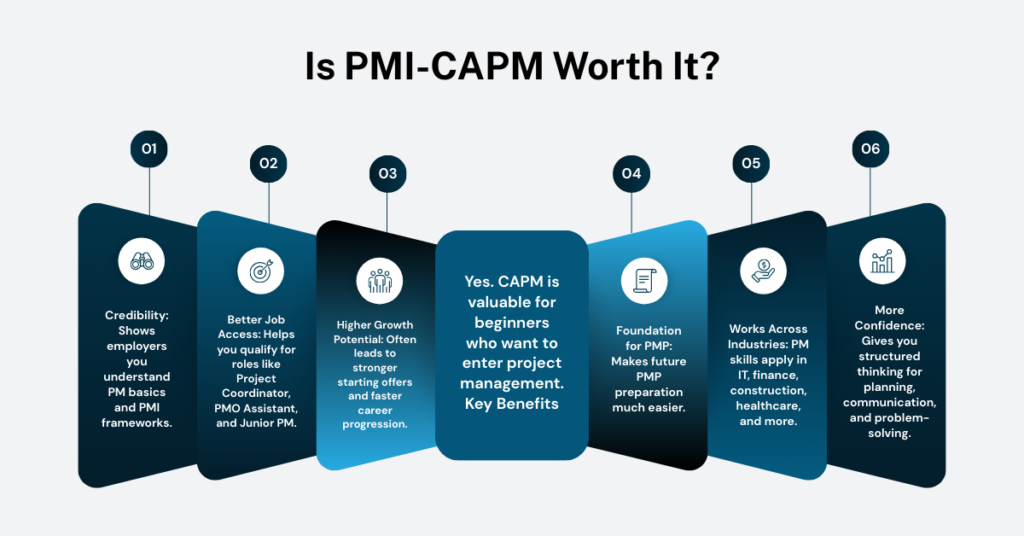
The Certified Associate in Project Management (PMI-CAPM) is generally considered worth it for students, recent graduates, and early career professionals who want to work in project management without prior experience. It provides a structured way to learn the basics of project management, earn a recognized certification, and gain a competitive edge in entry-level positions in a relatively short period of time and at a lower cost than earning an advanced certificatio
1. Credibility Boost for Early- Career Professionals
For candidates with little or no project management experience, the CAPM provides formal validation that they understand the language, concepts, and processes of professional project work. This shows employers that you are invested in learning PMI-compliant best practices, rather than relying solely on general “adjustment” experience.
Recruiters and hiring managers often use certifications as a simple filter when reviewing large numbers of resumes. Taking the CAPM can transform you from a generalist to a highly project-oriented candidate, especially if your degree or previous work is not directly related to project management. This is especially useful for new graduates, career changers, or professionals with technical or operational experience who need reliable signals about their project management capabilities.
2. Better positioning for Entry-Level project roles
CAPM is most impactful at entry and junior levels, where formal experience requirements remain flexible. This will help you position yourself confidently in positions such as:
- Project coordinator or project support officer
- Junior project manager or assistant
- Analyst or PMO Assistant (Project Management Office)
- IT, consulting, or service implementation or delivery coordinator
These roles often require an understanding of the planning, scoping, risk, communication, and stakeholder management involved in CAPM programs. With CAPM in your profile, you demonstrate that you already understand how projects are structured, what tools and processes are used, and how to effectively support project managers. In a competitive market, this can lead to more phone interviews, faster pre-hiring time, and a faster transition from a support role to full ownership of a project. When employers know they have a standardized knowledge base, they can more confidently assign responsibilities such as maintaining project plans, tracking risks and issues, and coordinating with cross-functional teams.
3. Improved Salary and growth potential
Although the CAPM itself does not guarantee a specific salary, it will often result in a better offer compared to non-certified candidates with the same experience level. Many organizations view certifications as a differentiating factor when choosing between two similar profiles, which can impact eligibility for starting salaries, annual raises, or internal transfers to project positions. The combination of CAPM and work experience will result in faster advancement to mid-level positions with significantly higher compensation ranges over time. CAPM allows you to take on structured responsibilities early in your career so you can have a measurable impact on project execution, including improved schedules, reduced rework, and improved stakeholder communication, which can contribute to performance reviews and promotions.
4. Strong foundation for PMP and advanced certifications
Another important benefit of the CAPM is that it provides a solid foundation for more advanced certifications, especially for project management professionals (PMPs). CAPM introduces the PMBOK structure, core process groups, knowledge areas, and terminology. These are also the core of PMP, but at a more understandable level. Once you have the project experience you need for PMP, you don’t have to start from scratch. Since you already understand concepts such as work breakdown structure, critical path, risk response, and change management, your transition to PMP preparation will be smoother and faster. This gradual path (CAPM → Experience → PMP) is often more realistic for new professionals than moving directly to a more advanced skill level without a structured foundation.
5. Transfer skills across industries and Domains
The principles you learn in preparation for the CAPM, such as planning, stakeholder engagement, risk management, and quality assurance, are not limited to one job sector or role. These can be applied in the fields of information technology, finance, manufacturing, construction, healthcare, education, and startups. This means that even if you later change industries or take on a role that combines project and product management, business analysis, or operations, the certification will add value. CAPM knowledge will serve you well as your career progresses, as the ability to structure work into projects, define clear deliverables, and manage deadlines and budgets is always in demand.
6. Professional confidence and structured thinking
In addition to external recognition, CAPM provides internal benefits as well. CAPM provides a structured mental model of how a project should be planned and executed. It assists to think in terms of scope, baseline, risk, dependencies, and stakeholder expectations rather than addressing problems in an ad hoc manner. This structured thinking improves communication with managers, clients, and team members. You can ask better questions, anticipate problems in advance, and suggest practical improvements to the way you organize your work. For many students, increased confidence and clarity are among the most tangible daily results of using CAPM.
CAPM vs PMP Certification
The Certified Associate in Project Management (CAPM) serves as an entry-level certification, while the Project Management Professional (PMP) certification is for experienced leaders. CAPM requires no prior experience. All you need is a high school diploma and 23 hours of project management training, and even beginners can join. In contrast, a PMP requires 36 to 60 months of project management plus 35 hours of training (which can be waived with CAPM) with a more rigorous exam focused on practical application.
Basis | CAPM | PMP |
| Experience | Not required | 36 months (diploma) or 60 months (secondary education) |
| Education | 23 Contact Hours | 35 Contact Hours (or CAPM) |
| Exam | 150 questions, 3 hours, Knowledge Based | 180 questions, 230 minutes, application based |
| Difficulty | Easier 70% Pass rate with Prep | More challenging, validates leadership. |
| Target audience | Students, freshers, students, career changers | Experienced project managers looking to advance their careers. |
| Cost Members | $225 | $425 |
| Salary Boost | Entry-level positions offer 15-20% | Higher ~$118,000. |
CAPM vs PRINCE2 and Agile
Basis | CAPM (PMI) | PRINCE2 | Agile |
| Experience | None required | None for foundation, recommended for Practitioners | Varies, Some experience preferred |
Focus | PMBOK fundamentals, predictive/agility/hybrid | Process-based Governance, Stages and Roles | Iterative delivery, adaptability, sprints |
| Target Audience | Beginners, students, career changers | Government/IT professionals, mainly in Europe/UK focus | Agile teams, software developers |
| Exam Format | 150 MCQ, 3 hours | Fundamentals: 60 questions. Practitioner: 68 scenario questions. | Varies (e.g. ACP 120 questions, 1 hour) |
| Cost Approx (USD) | $225-300 | $250-500 foundation + Practitioner | $400-1,000 |
| Validity | 3 years, 15 PDUs | 3-5 years, varies | 3 years, PDU/CEU |
Best For | Entry level global project manager role. | Structured and regulated project. | Develop and change quickly. |
Also Read pmi-pgmp-certification-for-program-managers
Who should consider PMI-CAPM?
PMI-CAPM is Ideal for you if
You’re just starting your project management journey
The Certified Associate in Project Management (CAPM) is specifically designed for entry-level professionals with little or no project management experience. Whether you’re a recent graduate, a current student, or just starting your professional career, CAPM provides a solid foundation to learn the fundamentals of project management without requiring thousands of hours of experience.
You transition from a technical or non-chancellor position
CAPM is useful for engineers, developers, business analysts, quality assurance specialists, and other technical professionals looking to get into project management. This shows that you understand PM methodologies and terminology, making you a more reliable candidate for coordinator and junior PM positions. Business analog analysis that helps in project development cannot be formally performed in PM projects. You can test your project’s performance using CAPM.
You need a credential while building experience
If you’re already involved in projects but don’t yet meet PMP’s rigorous experience requirements (3-5 years of PM experience), you can use CAPM to earn your PMI certification today. This shows employers that you take your profession seriously and are invested in learning industry standard practices.
You may want to skip CAPM if
You’re already an experienced project manager
If you have 3+ years of PM project management experience (4,500+ hours with a bachelor’s degree or 7,500+ hours without a degree), you should instead pursue the PMP certification directly. If you already have the kind of experience that employers actually value, the CAPM won’t add much value to your resume, so you’re better off investing that time and money in the more prestigious PMP certification.
You are in a senior or managerial position
Senior project managers, program managers, portfolio managers, or executives should earn advanced certifications such as PMP (Program Management Professional), PMP (Portfolio Management Professional), or specific certifications in agile leadership. CAPM is clearly an entry-level certification, and higher levels do not add credibility. You may also ask why you need to obtain an associate-level certificate.
Professional or industry qualification required
If your career focuses on agile implementation, you may benefit even more from a PMI-ACP or Scrum certification. If you’re in IT service management, ITIL may be a better fit. In professional fields, domain-specific certifications are often given more weight than general entry-level PM certifications.
How to get certified, step-by-step roadmap

Getting your PMI-CAPM certification is a clear and structured process that typically takes 2 to 4 months from start to finish. Here’s how to complete each step:
Step 1: Complete 23 hours of project management training
Before applying to sit for the CAPM exam, PMI requires that you complete 23 hours of formal project management training. These hours must be provided by a PMI Authorized Training Provider (REP) or a course that covers the principles of the PMI Framework and PMBOK Guide.Now is not the time for self-paced training. Should be instructor-led training delivered by an approved provider.
This isn’t self study time– It should be instructor-led training delivered by an approved provider. A certificate of completion will be issued, which is necessary for applying for the exam. This training component covers the necessary foundational knowledge such as project integration, scope, schedule, cost, quality, resources, communication, risk, procurement, stakeholder management, and agile and hybrid approaches.
Step 2: Apply via PMI
After completing your training, create an account at PMI.org and submit your CAPM application. You will need to provide training details, educational qualifications and upload a certificate confirming that you have completed 23 hours of contact time. PMI reviews a certain percentage of applications, so please have your training certificate and all supporting documentation on hand. If you choose to undergo an audit, you must submit within a certain period of time.Registration fees are $225 for PMI members and $300 for non-members (PMI membership costs $129 per year, so joining will save you money if you plan on pursuing other PMI certifications).Once approved (usually within 5-7 business days), you have one year to schedule and take the exam.
Step 3: Schedule your exam
PMI will partner with Pearson VUE to administer the exam. You can choose to take the exam at a physical testing centre or online from home with remote proctoring. Online options offer more flexibility in scheduling, but require a quiet location, a stable internet connection, and a computer with a webcam. Plan your exam date strategically. After completing your course, please set aside 4-6 weeks of focused study time. The exam consists of 150 multiple-choice questions (only 135 are graded and 15 are pre-test questions). It will take 3 hours to complete.
Step 4: Prepare with Mock tests and structured study
Passing the CAPM requires more than just following the training. Special preparation for the exam is required, Focus on the following key strategies: Please actively train for the practical exam. Take a comprehensive training test under specific conditions to improve your endurance and identify weaknesses. Aim to consistently score 75% or higher on practice exams before scheduling your actual exam. Master process groups and knowledge areas. Understand how the five process groups (initiation, planning, execution, monitoring and control, and termination) interact with the ten knowledge areas. Many exam questions test your ability to determine which processes or tools apply to a particular scenario.
Step 5. Consider Agile content carefully
Approximately half of the exam will focus on predictive (waterfall) approaches and the other half will focus on agile/hybrid approaches. Don’t miss any area. Understand when each approach is appropriate and how you can combine them.
Review with PMI-specific terminology. PMI uses a specific language that may differ slightly from what you would encounter in the real world. Look up definitions of terms such as “incremental development,” “incremental planning,” and rolling wave planning and fast tracking vs crashing.
a-complete-guide-to-psm-1-certification-eligibility-benefits-and-career-scope
Real world Value, Job Market and Career Growth
CAPM provides tangible career benefits by notifying recruiters and hiring managers that entry-level candidates have PMI-verified foundational knowledge. This often acts as a key differentiator in bulk selection processes where experience gaps exist.
Recruiter and hiring manager perspective
Recruiters view the CAPM as a strong indicator of structured project management knowledge and will prioritise certified candidates for junior roles due to reduced training requirements. Many ATS systems report PMI credentials, increasing visibility by 20-30% in searches for project coordinator and PMO positions. Hiring managers appreciate that this equips new hires with PMBOK-compliant skills such as risk monitoring and stakeholder communication, allowing them to contribute more quickly to ongoing projects.
Example career scenario
- A fresh graduate became a project coordinator. A recent engineering graduate highlighted his understanding of the planning field in an interview, bypassing non-certified colleagues to land a 6 LPA co-ordinator job at an IT company and add CAPM to his CV.
- IT professional shifted into PM role: A developer with two years of experience uses CAPM to transition into a junior PM role at a consulting firm and leverages his execution knowledge to effectively manage agile sprints from day one.
- Business Analyst to PMO Analyst: Analysts earn CAPM for monitoring/supervisory experience, earn PMO support roles at 15% higher pay, and accelerate promotion to full PM in 18 months.
- These results highlight the role of CAPM in unlocking entry-level opportunities and driving 1-2 year growth trajectories in IT, consulting and other sectors.
CAPM Study Resources & Budget Breakdown
PMBOK Guide (Free for PMI members)The Project Management Body of Knowledge (PMBOK) is the primary source of information for CAPM. Joining PMI as a member is completely free ($129/year). The digital version gives you access to the latest 7th edition, which covers all the fundamentals, processes, and principles tested on the exam. PMBOK may seem boring and theoretical, but it is important for understanding the specific terminology and approach of PMI. You don’t need to memorize every page, but you should be familiar with the 12 principles of project management, the eight performance areas, and the differences between predictive, agile, and hybrid approaches. Use PMBOK as a reference guide, not as your only study material. Supplement it with more easy-to-understand resources that explain concepts in practical terms.
Recommended study timetable and schedule
Preparing for the CAPM exam requires a structured study plan that combines study concepts, review, and practice. Depending on your availability and professional commitments, you can choose between an intensive 4-week plan or a balanced 8-week plan. 4-week intensive study plan. This plan is perfect for learners who can spend 3-4 hours per day and want to complete their preparation in less time.
Week 1: PMBOK Knowledge Area (20 hours)
Focus on basic project management concepts, process groups, and key terminology and structures explained in the PMBOK guide. This week your foundation will be laid.
Week 2: Agile Hybrid Approach + Flashcards (15 hours)
Learn the concepts of agile and hybrid projects, followed by regular flashcard-based reviews to strengthen your understanding of terminology and processes.
Week 3: Practical questions (20 hours)
Attempt around 300 practice questions to understand the exam pattern, improve time management, and identify weaknesses.
Week 4: Complete practice exams and final test (15 hours)
Thoroughly test your model, check for incorrect answers, and review key concepts. This week you should focus on boosting your confidence and preparing for the test.
General guide:
Study 3-4 hours a day
Track your progress weekly
Always aim for a score of 70% or higher on practice tests before planning your exam.
8 weeks balanced training plan (for working adults)
This plan is for professionals who prefer to make steady progress with 1-1.5 hours per day and slightly longer sessions on weekends.
Weeks 1-2: Basics (10 hours per week)
Learn basic concepts, terminology, and project management process groups.
Weeks 3-5: Deep Learning and Video Exploration (12 hours per week)
PMBOK topics are covered in detail with video explanations and concept reinforcement.
Weeks 6-7: Practical (15 hours per week)
Focus on practice questions, scenario-based learning, and mock exams to apply concepts effectively.
Week 8: Review and Exam Planning (10 hours)
Final exams and comprehensive mock exams for important areas and weak topics.
Please schedule your exam 1-2 weeks after you are ready.
Senseacademy, PMI-Aligned CAPM training
As a structured training program that meets PMI standards, it meets the 23-hour training requirement while providing comprehensive exam preparation. This course covers all exam areas, provides practice questions, and provides a certificate of completion needed to apply for PMI. It essentially acts as a one-stop solution for prerequisite educational requirements. Senseacademy offers a structured PMI-CAPM certification training program designed to support individuals in the early stages of project management. This program meets PMI standards and meets the 23-hour contact time requirement, helping students meet exam requirements while developing a solid understanding of basic project management concepts, terminology, and work processes. This training systematically covers all areas of the CAPM exam, includes practice questions to assess your readiness, and provides a certificate of completion for the PMI application process. This approach helps students prepare with confidence while developing a fundamental understanding of project management practices. This training and certification material is available to professionals in India, Dubai, Bahrain, and the Middle East.
FAQ’s
1. What is CAPM Certification?
CAPM (Certified Associate in Project Management) is an entry-level certification offered by PMI. It validates the knowledge of project management concepts, terminology, and standard practices. Suitable for those starting or entering a project management career.
2. Who should consider CAPM certification?
CAPM is ideal for students, recent graduates, entry-level professionals, and members of technical teams transitioning into project-oriented roles. It is also useful for business analysts and coordinators who require structured knowledge in project management.
3. Do I need specialized experience to apply to CAPM?
No project management experience required. To meet PMI’s selection criteria, applicants must have a high school diploma and 23 hours of project management training.
4. What study resources recommended for CAPM preparation?
The PMBOK guide is the main reference material. Mock tests, flashcards, and video explanations are often used to improve exam comprehension and performance.
5. How long does it take to prepare for the CAPM exam?
Most candidates prepare within 4-8 weeks , depending on daily availability.
An intensive study plan combined with regular practice tests will help ensure your exam preparation.
6. How soon should I schedule my exam after preparation?
It’s recommended that you schedule your exam within 1-2 weeks of completing your study plan. This will keep the concept fresh and give you time to make final decisions.
Conclusion
The CAPM certification is a good starting point for anyone looking to build or transition into a career in project management. Validating basic knowledge of project management principles, processes, and terminology will help future professionals demonstrate their readiness to take on project-oriented roles and structured work environments. This is especially useful for students, new graduates, and professionals who need clarity and direction in their project management process. With a well-planned research approach, appropriate resources, and consistent practices, CAPM preparation can be completed within a reasonable time frame. Certifications not only improve job readiness but also create a clear path to future growth towards advanced project management skills. Overall, CAPM provides a practical, structured, and reliable way to start building a long-term project management experience.