
Compare PRINCE2 and Scrum to choose the right project management methodology based on team structure, project size, risk level, and flexibility needs. As today’s projects don’t fail because teams lack effort, they fail because the way the work is managed does not correspond to the reality of the project. Requirements change, deadlines tighten, stakeholders expect transparency, and teams must complete tasks faster with fewer resources. In this type of environment, choosing the right project management approach can make all the difference between continued progress and continued frustration. PRINCE2 and Scrum are two of the most popular frameworks used for project management, but they are designed for very different situations. PRINCE2 focuses on structure, clear roles, and controlled stages, making it a strong choice for projects where governance and predictability matter. Scrum, on the other hand, is designed for adaptability. This helps teams respond quickly to change, collaborate closely with stakeholders, and create value in small, frequent steps.
The problem is that many organizations choose a methodology based on trends, importance or popularity of certifications rather than the actual needs of the project. Highly regulated projects can struggle with a purely agile approach, while fast-paced product teams can feel constrained by heavy amounts of documentation and tight controls. This article reveals the real differences between PRINCE2 and Scrum, explains when each approach works best, and helps you choose a methodology that fits your project context, team dynamics, and business goals without unnecessary complexity or buzzwords.
Overview of PRINCE2 Methodology
Overview of PRINCE2 Methodology
PRINCE2 stands for Projects in a Controlled Environment and is a structured project management methodology based on clarity, accountability, and control. It is widely used in industries that require tight control of projects, clearly defined roles, and special attention to effective management of risks and resources. At the heart of PRINCE2 is the idea that a project always needs a clear business case. From the moment a project begins, teams need to understand why it exists, what value it brings, and whether it should continue as circumstances change. This emphasis helps organizations avoid investing time and money in projects that no longer make sense.
PRINCE2 breaks projects into manageable stages, making progress easier to plan, monitor, and control. Each stage has defined objectives, deliverables, and approval points, ensuring that senior management remains involved without micromanaging day-to-day work. Clear roles such as the Project Board, Project Manager, and team members help everyone understand who is responsible for decisions and outcomes. PRINCE2 is not rigid and is designed to accommodate projects of various sizes and environments. This can be simplified for small initiatives or more detailed for complex, high-risk projects. This flexibility, combined with a strong governance structure, makes PRINCE2 particularly effective in regulatory sectors, public sector projects, and large-scale organizational change efforts where control and transparency are essential.
Overview of Scrum1 Methodology
Scrum functions as a lightweight framework that helps teams learn, adapt, and perform better in uncertain environments. It was created for situations where requirements may change and detailed plans drawn up in advance do not always correspond to reality. Scrum encourages teams to move forward in small, focused cycles rather than trying to define everything from the beginning. Work is done in short iterations called sprints, which allow teams to quickly test ideas, gather feedback, and make improvements before moving on. This provides visibility into progress and reduces the risk of creating something that no longer meets the needs of the business.
Scrum puts people at the center of implementation. Clear roles such as Product Owner, Scrum Master and Development Team help ensure accountability, but decision-making is shared rather than controlled top-down. Teams are trusted to organize their work, collaborate closely and continually improve their work. Rather than relying on heavy documentation or rigid plans, Scrum focuses on conversation, transparency, and real results. Regular reviews and retrospectives help teams reflect on what’s working and what’s not. This human-centered, flexible way of working is why Scrum is widely used in software development, digital products, and fast-moving business environments where learning and adaptability matter more than strict control.
Visit importance-of-psm-ii-in-todays-agile-world
Overview of Scrum Methodology
Skill set required for PRINCE2 certification
The PRINCE2 certification emphasizes the ability to think, plan, and manage responsibilities in a structured environment, rather than technical expertise. You don’t need to be an expert project manager to get started, but there are certain skills that will make learning and applying PRINCE2 easier. Strong organizational thinking is one of the most important skills. PRINCE2 projects are based on clear plans, defined roles, and structured steps, so the ability to organize information, track progress, and follow processes is essential. People who like clarity and order tend to adapt quickly to PRINCE2’s way of working.
Communication and stakeholder management skills are equally important. PRINCE2 emphasizes reporting, escalation and decision-making through defined management channels. This means you must be able to communicate clearly with senior management, justify decisions using data, and present project status in a structured manner. Another important skill is risk awareness and decision making. PRINCE2 encourages proactive risk identification and controlled response rather than reactive problem solving. Candidates who can assess impacts, evaluate options, and make informed recommendations will find this framework intuitive. Finally, attention to detail and discipline play a key role. PRINCE2 requires an understanding of management topics, processes, and products, which requires focus and consistency. Although the methodology is adaptable, it requires practitioners to apply the framework carefully, making it suitable for professionals who value predictability, accountability, and stability in long-term projects.
Skill set required for Scrum1 certification
Scrum Certification is less about memorizing rules and more about understanding how people collaborate, adapt, and create value together. Previous experience working in an agile environment is helpful, but many professionals succeed by developing the right mindset and core skills, not just technical knowledge. One of the most important skills is adaptability. Scrum is designed to accommodate change, so it’s important to be comfortable with changing priorities and changing requirements. Candidates who can remain flexible, learn quickly from feedback, and adjust their plans without frustration tend to thrive in Scrum environments.
Collaboration and communication play a central role in Scrum. The team works closely with stakeholders, openly discussing progress and resolving issues together. This requires active listening, clear communication, and the ability to give and receive constructive feedback without getting defensive. Scrum also emphasizes self-management and responsibility. Team members are expected to take responsibility for their own work rather than waiting for instructions. For roles such as Scrum Master or Product Owner, this extends to facilitating discussions, removing obstacles, and helping teams achieve continuous improvement.
Difference Between PRINCE2 and Scrum1
| Aspects | PRINCE2 | Scrum1 |
| Overall Nature | Structured project methodology | Agile framework focused on adaptability. |
| Primary Focus | Control, governance and predictability | Flexibility, collaboration and fast feedback |
Planning Style | Detailed planning in advance with step-by-step control | Iterative planning with short sprints |
Handling Change | Changes are formally evaluated and approved. | Change is expected and easy to adapt to |
Decision Making | Centralized through project board and management roles. | Shared decision-making within the team |
Best For | Large-scale regulatory projects (government offices, construction) | Dynamic and uncertain environment (technology, startups) |
| Documentation | Formal and structured documentation | Minimal documentation, results oriented |
| Planning | Detailed long-term planning and documentation from the start | Short backlog queue, expandable as needed |
Stakeholder Involvement | Periodic involvement with reports and reviews | Continuous involvement regular participation with reports and reviews |
Opportunities after PRINCE2
1. Access to globally recognized roles within the project
PRINCE2 certification opens the door for project managers in international markets. Certified professionals are widely recognized in the UK, Europe, Australia and parts of Asia and are therefore often considered for employment on global or cross-border projects. This global reputation makes PRINCE2 particularly valuable for professionals seeking to collaborate with multinational organizations and government initiatives.
2. Faster career advancement to management positions
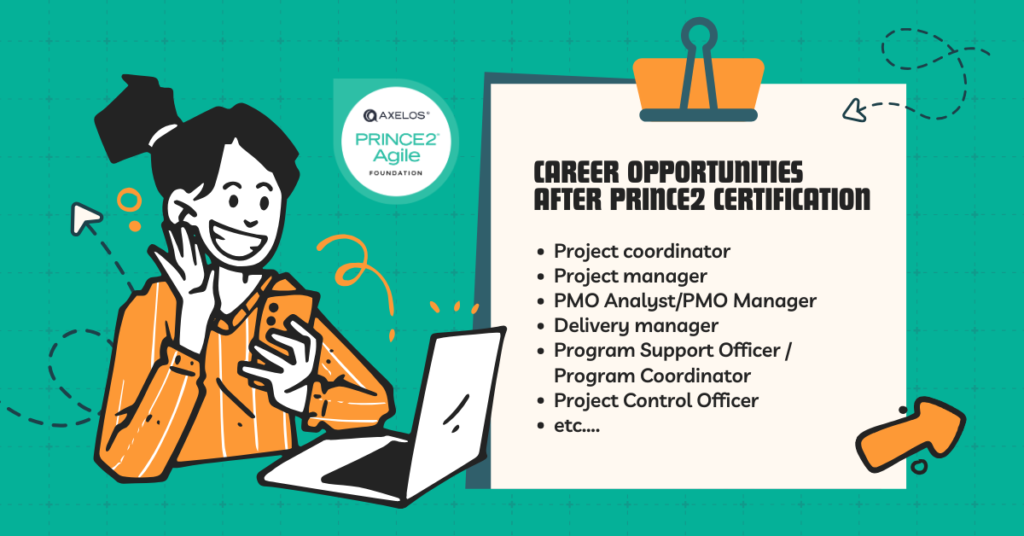
PRINCE2 certified professionals often advance quickly into leadership roles such as project managers, delivery managers, and PMO managers. This methodology focuses on governance, accountability, and decision-making, allowing individuals to take responsibility for complex projects and engage with key stakeholders with confidence.
3. Opportunities across multiple industries
One of PRINCE2’s greatest strengths is its industrial neutrality. Certified professionals are not limited to the IT field. They can work in fields such as construction, healthcare, finance, consulting, and government services. This flexibility allows career development without having to start over if professionals decide to change sectors.
4. Promotion to PMO and governance focused roles
PRINCE2 is popular in project management offices (PMOs) due to its structured approach to control, reporting, and milestone management. Earning your certification creates opportunities for advancement into roles such as PMO Analyst, Project Management Manager, and Governance Manager. Ensuring consistency and compliance across projects is essential in these roles.
Opportunities after Scrum1
1. Role of project manager and senior project manager
The PRINCE2 certification is most commonly associated with project management positions, where professionals are fully responsible for planning, managing, and executing projects. As they gain experience, certified professionals move into senior project manager or senior project manager positions, managing higher budgets, complex stakeholders, and strategic initiatives that directly impact business outcomes.
2. Careers in PMO and governance focused roles
Many PRINCE2 certified professionals move into project management office (PMO) roles such as PMO analysts, PMO managers, and project management managers. These roles focus on standardizing project delivery methods, monitoring performance, ensuring compliance, and increasing implementation maturity across the organization. Because PRINCE2 is administratively focused, these positions are highly valuable.
3. Delivery manager and program support roles
As PRINCE2 specialists gain experience, they often move into the role of implementation manager or program coordinator. These roles oversee multiple related projects, manage dependencies, monitor workflow risks, and ensure alignment with business objectives. This is a natural progression for those who want to work on a broader, strategic level rather than a single project.
4. Opportunities in various industries
PRINCE2 field is industry neutral, so career advancement is not limited to the IT field. Certified professionals find opportunities in the construction, healthcare, finance, consulting, government, and engineering industries. This flexibility allows individuals to change industries without relearning an entirely new approach to project management, greatly expanding their long-term career options.
Exam Structure for PRINCE2
Familiarize yourself with the PRINCE2 exam before you start preparing. Before you open a study guide or take a practice test, it’s important to understand what is actually expected of you on the PRINCE2 exam. Think of it like learning the rules before a match. It helps you prepare smarter, not harder. There are two main levels of the PRINCE2 qualification, both of which are based on the same system but test different skills and levels of understanding. PRINCE2 basic exam This level focuses on knowledge and understanding. Ideal for beginners and experts who are new to the PRINCE2 framework.
Objective: Test your understanding of PRINCE2 principles, topics, processes, and terminology.
Format: 60 multiple choice questions.
Exam time: 60 minutes
Passing score: 55% (33 out of 60 questions correct)
Book open/close: Book closed
Preparation Tips for PRINCE2
1. First, understand the PRINCE2 framework. Start by understanding the big picture: the seven principles, seven themes, and seven processes. Rather than cramming definitions, focus on why each element exists and how they relate throughout the project lifecycle. This foundation makes everything else easier.
2. Knowing your exam level Preparation varies depending on the exam.
Fundamentals: Focus on key concepts, terms, and facts. Practitioners: Practice applying PRINCE2 to scenarios and decisions. Tailor your study plan to your learning level to help you stay focused.
3. Use the official PRINCE2 guide wisely. For the practitioner exam, the official PRINCE2 guide is the most helpful. Don’t just read, learn how to read quickly. Use sticky notes, highlights, or tabs to quickly find processes, roles, and topics during your exam.
4. Practice with scenario-based questions. Especially for practitioners, mock exams can help you get into the mindset you need for the exam. Analyse the scenario, determine what stage your project is at, and practice choosing the best answer based on PRINCE2, not just the technically correct answer.
5. Create quick notes and visuals. PRINCE2 may seem heavy at first. Break it down into mind maps, flowcharts, or pivot tables. Visual learning helps you more effectively recall connections between processes, roles, and documents.
6. Focus on roles and responsibilities. Many exam questions test your understanding of who does what in PRINCE2 (project managers, project committees, team leaders, etc.).By being clear about this, your score will immediately improve.
7. Manage your time during the exam, Practice answering the questions within the time limit. Practitioners: Don’t stick to one scenario. Write it down, move on, and come back to it later. Time management is often the difference between success and failure.
Important Notes
Both exams meet the official PeopleCert PRINCE2 certification guidelines.
The exam format, scores and syllabus may be updated by PeopleCert.
Always refer to the PeopleCert PRINCE2 official website for the latest exam information.
Exam Structure for Scrum1
Scrum Certification Exam Structure, Before you start preparing for your Scrum certification, it’s important to understand how the exam is structured and what it actually tests. Scrum exams are not rote memorization. Assess how well you understand Scrum values, roles, and events, and how you apply them to real-world situations. The structure may vary slightly depending on the certification body, but most professionals choose PSM (Professional Scrum Master) or CSM (Certified Scrum Master). The overall structure of the exam is as follows:
Professional Scrum Master (PSM I) – Exam Structure
The PSM I exam is knowledge-driven and tests your deep understanding of the Scrum Guide. Exam format: multiple choice, multiple choice, true/false.
Number of questions: 80 questions
Exam time: 60 minutes
Passing score: 85%
Book open/close: Book closed
Delivery method: Online (can be picked up from anywhere)
Questions are often complex and conceptually based, requiring a true understanding of Scrum rather than relying on memorization.
Preparation Tips for Scrum1
Master the Official Scrum Guide
Preparing for your Scrum certification starts with the Scrum Guide, the single source of truth for all Scrum exams. Rather than reading it once, candidates should read it again and again to fully understand how Scrum’s roles, events, artifacts, and values work together. Many exam questions are intentionally designed to test understanding of the guide rather than testing how widely Scrum is practiced within an organization.
Develop a true Agile and Scrum mindset
The Scrum Certification Exam doesn’t just test your knowledge. They check perspective. It’s important to understand why Scrum promotes self-management, transparency, and continuous improvement for teams. When you move from a traditional command-and-control approach to an agile mindset, answering scenario-based questions becomes much easier because you naturally choose answers that reflect Scrum values and principles.
Using practice exams to improve understanding
Practice tests are one of the most effective preparation tools when used correctly. Scrum.org’s free public tests and popular practice exams like Mikhail Lapshin’s quizzes can help you understand exam patterns and difficulties. The real value comes from checking incorrect answers, identifying weaknesses, and revisiting the Scrum Guide to close knowledge gaps until you consistently score well.
Learn to respond from a Scrum Mindset
One common challenge candidates face is answering questions based on workplace habits rather than Scrum theory. The Scrum exam requires answers rooted in servant leadership, accountability, and transparency. When faced with difficult scenarios, making the right choices, even if they feel counterintuitive, almost always supports team autonomy, openness, and continuous learning. Connecting Scrum concepts to real-world scenarios. The exam tests your understanding, judgment, and Agile mindset so the right preparation approach matters.
Choosing b/w PRINCE2 and Scrum1
Important factors to consider when choosing between PRINCE2 and Scrum. The choice between PRINCE2 and Scrum is not about which one is better. What matters is not how your project looks on paper, but how it works in practice.
1. How clear are the up-front requirements?
If you already know exactly what you have to deliver, how long it will take, and what success looks like, you will usually feel more comfortable with PRINCE2. It succeeds through clarity and structure. However, if the project is still evolving (ideas change based on customer feedback or market changes), Scrum makes more sense. Scrum recognizes that you won’t have all the answers on day one, and that’s okay.
2. What changes are expected during the project?
Some projects require stability. You don’t want your scope of work to change every week, especially when it comes to budgets, contracts, and compliance. This is where PRINCE2 is a natural fit. PRINCE2 is designed to manage change rather than constantly reacting to it. Scrum, on the other hand, assumes that change will occur. When adapting quickly is more important than sticking to a fixed plan, Scrum allows teams to adapt without slowing down the process.
3. How does your team prefer to work?
PRINCE2 works best when roles, responsibilities, and decision-making authority are clearly defined from top to bottom. The team follows a structured process with clear boundaries. Scrum allows teams to manage their work. If your team values autonomy, collaboration, and frequent feedback, Scrum will generally feel more natural and motivating.
4. Required level of control and reporting
Whether your project involves high-level stakeholders, audits, approvals, or regulatory oversight, PRINCE2 provides the language and structure that management expects. Business cases, approval procedures, and formal reporting are integrated into the method. Scrum makes things simple.It emphasizes transparency through regular reviews and demonstrations rather than formal documentation. This works well for teams where trust and visibility are more important than paperwork.
5. The type of project you are leading
PRINCE2 is often suitable for construction, infrastructure, government or large corporate projects where predictability is important.Scrum appears in the development of software, digital products, and innovation projects where learning and experimentation are part of the journey.
6. Your organization’s culture
Even the best methodology will fail if it conflicts with the company’s culture. Organizations that emphasize control, documentation, and hierarchy tend to be successful with PRINCE2. Companies that value speed, flexibility, and continuous improvement often find Scrum easy to implement and maintain.7.You don’t have to choose just one
Many organizations do not choose between PRINCE2 and Scrum, but use both. PRINCE2 provides the structure and overall management of the project, while Scrum ensures day-to-day implementation. This hybrid approach is becoming increasingly popular in enterprise environments.
Read pmi-capm-certification-is-it-for-you-how-can-you-benefit-from-it
Benefits of PRINCE2 Certification
PRINCE2 continues to be a trusted and respected choice for project management, especially for professionals seeking clarity, reliability, and long-term career stability. Recognized in more than 150 countries, it is a powerful authority for people looking to work with global organizations or travel to regions such as the UK, Europe, Australia and Asia. What really sets PRINCE2 apart is its accessibility. You don’t need years of experience to get started. Whether you’re getting into project management for the first time or want to consolidate the skills you’ve learned on the job, PRINCE2 provides a clear, structured way to build confidence, improve your employability, and maintain your position in a competitive job market.
For organizations navigating increasingly complex and hybrid ways of working, PRINCE2 offers something equally valuable: balance. It brings order to projects through defined roles, clear accountability, and proactive risk management, without becoming rigid or outdated. Teams can scale the structure to suit small initiatives or large transformation programs, and where flexibility is required, PRINCE2 Agile allows them to combine effective management with iterative, agile delivery. This ability to combine structure and adaptability is why PRINCE2 continues to work so well in real-world projects, helping teams stay aligned, make better decisions and achieve results that actually align with business goals.
Visit professional-scrum-master-i-psm-certification
Benefits of Scrum1 Certification
Becoming a Certified Scrum Master isn’t just about getting a certification: it’s about truly understanding how modern teams work and how value is achieved in a rapidly changing environment. The Scrum Master Certification will help you gain a solid, practical understanding of the Scrum framework, from its core principles and values to the practical skills needed to lead teams in solving complex problems. For beginners, it provides a clear and confident understanding of agile working methods. For experienced professionals, it deepens existing knowledge and develops leadership skills. Just as important, certification fosters an agile mindset that prioritizes collaboration, transparency, continuous improvement, and adaptability, enabling teams to work better together and respond effectively to change.
From a professional perspective, the Scrum Master Certification can be a real game-changer. Certified professionals are often viewed as more reliable and work-ready, giving them a significant advantage in hiring and internal promotions. Many organizations are actively seeking Certified Scrum Masters and are willing to compensate them for their skills, with salaries increasing significantly depending on location and experience level. Beyond pay, certifications open doors to a wide range of roles, from agile trainers and product owners to delivery and transformation leaders, and connect professionals to the global agile community. There, the learning and opportunities continue long after the exam. For organizations, becoming a Certified Scrum Master means smoother delivery, stronger teams, faster time to market, and a more flexible approach to change, making the certification valuable on both a personal and professional level.
PRINCE2 vs Scrum1
Which one is best suited for your team, project size, and risk level?
PRINCE2 and Scrum are not only different processes, they reflect two very different ways of organizing people and managing uncertainty. Understanding how each handles order, complexity, and risk will make your choice clearer.
Team structure and decision making
PRINCE2 works best when your team requires a clear hierarchy. Roles are predefined, authority is delegated from above, and decisions follow a structured path. Everyone knows who approves what, who escalates issues, and who is responsible for each risk. This structure reduces confusion within large teams, but can slow down processes when quick decisions are needed. Scrum takes the opposite approach. Teams are self-organizing and decisions are closely related to work. Scrum relies on collaboration and shared responsibility, not hierarchy. This allows teams to be faster and more responsive, especially when requirements change frequently.
Actual roles and responsibilities
PRINCE2 clearly separates the roles of the project board, the project manager, and the team manager. Accountability is formal and documented, which is reassuring in corporate and regulatory environments where mistakes can be costly. Scrum simplifies the roles of Product Owner, Scrum Master, and Developer. Responsibility is shared, and success is highly dependent on communication and trust. This arrangement works well when the team has the experience and authority to manage the work.
Manage project size and complexity
PRINCE2 tends to be better suited for large projects involving multiple teams and multiple stakeholders. A step-by-step approach breaks down complexity into manageable parts and ensures consistency at each step of important decisions. Scrum is most effective for small or medium-sized projects and product development efforts, where complexity is more due to uncertainty than size. Address complexity by delivering services in short cycles and learning quickly from feedback. Risk management: control and adapt. PRINCE2 manages risk through planning, documentation, and formal analysis. Risks are identified early, continuously monitored, and assigned clear ownership. This approach is effective when the risk is related to compliance, contracts, or fixed budgets. Scrum reduces risk by failing early at minimal cost. By delivering small increments and reviewing frequently, your team identifies issues before they become major issues. This is ideal when the risk is due to changing customer needs or unknown technical issues.
Which one fits better?
When your project is large, high-risk, and requires strong management, PRINCE2 provides the control and clarity you need to make it a success. If your project is evolving, rapidly evolving, and dependent on customer feedback, Scrum provides the flexibility and speed you need to effectively manage uncertainty. For many organizations, the most practical answer is not to choose one, but to combine the two: PRINCE2 for senior management and Scrum for day-to-day operations.
There is no universal “best” choice between PRINCE2 and Scrum. The right decision depends on understanding the complexity of the project, the level of risk, the maturity of the team, and the organizational culture. In many cases, the strategic control of PRINCE2 combined with the flexibility of Scrum creates a balanced and highly effective approach. Choosing methodologies based on actual needs rather than trends creates the conditions for sustainable progress, better decision-making, and results that truly support long-term business goals.
Senseacademy PRINCE2 Foundation certification
The PRINCE2 Foundation certification provides professionals with a fundamental understanding of the PRINCE2 project management methodology. Participants learn the key principles, processes, topics and terminology needed to effectively manage projects. This certification is ideal for individuals interested in improving their project management skills or pursuing a career in project management. By achieving the PRINCE2 Foundation certification, candidates demonstrate their knowledge of best practice in structured project management, enabling them to contribute effectively to project teams and organizations using the PRINCE2 methodology.
prince2-foundation-certification-course
FAQ’s
1. Which is better: PRINCE2 or Scrum1?
Neither one is better than the other by default. PRINCE2 is best suited for projects that require structure, governance, and predictability, while Scrum works best in fast-paced environments where flexibility and continuous feedback are essential.
2. Should I choose PRINCE2 or Scrum for my project?
Look at your project reality. If requirements are clear and control is critical, choose PRINCE2. If requirements change and speed is an issue, Scrum is a better solution.
3. Can PRINCE2 and Scrum be used together?
Yes. Many organizations use PRINCE2 for high-level management and control, while Scrum provides day-to-day delivery. This hybrid approach provides both control and adaptability.
4. Which certification is best for career advancement?
Both offer strong career opportunities. PRINCE2 supports project management, PMO, and governance roles, while Scrum opens the door to agile, product, and transformation-focused roles.
5. What is the biggest mistake organizations make when choosing a framework?
Selection is based on certification trends and popularity rather than project needs. Long-term success is achieved by aligning the structure to project complexity, team culture, and company goals.
Conclusion: The right choice for a successful long-term project
The long-term success of a project does not depend on hard work or the adoption of the most popular methodologies.It’s all about choosing an approach that truly adapts to the nature of the project, the way your team works, and the expectations of your stakeholders. When your management style corresponds to the realities of your project, your team can approach their work with clarity, confidence, and determination.
PRINCE2 is ideal for projects that require structure, control and predictability. It provides a robust decision-making process that works well in large initiatives and projects with clear roles, managed milestones, and regulated environments, fixed scope and high levels of responsibility. Scrum, on the other hand, excels in environments where change is constant. Our iterative implementation, close collaboration with stakeholders, and commitment to continuous improvement make us ideal for innovative, fast-paced projects.
There is no universal best choice between PRINCE2 and Scrum. The right decision depends on understanding the complexity of the project, the level of risk, the maturity of the team, and the organizational culture. In many cases, the strategic control of PRINCE2 combined with the flexibility of Scrum creates a balanced and highly effective approach. Choosing methodologies based on actual needs rather than trends creates the conditions for sustainable progress, better decision-making, and results that truly support long-term business goals.