

The Six Sigma Yellow Belt is often regarded as the entry point to the field of quality management and process improvement. Despite being an entry-level qualification, it gives professionals the fundamental abilities that form the basis of long-term professional success. The Yellow Belt program introduces students to Six Sigma terminology, clarifies its organized process, and demonstrates how minor adjustments can produce significant outcomes. For people looking to progress their careers and develop their problem-solving abilities, this certification is quite beneficial.
Table of Contents
Yellow Belt: The Foundation of Six Sigma

The Yellow Belt usually represents the first certification for every Six Sigma journey, and it serves as the foundation for more advanced certifications like the Black Belt. At this point, the emphasis is on gaining a fundamental understanding of the DMAIC methodology, teamwork, and process improvement principles. Although they might not be responsible for projects, Yellow Belts are essential for the bigger projects that Green and Black Belts are leading. Professionals can more easily progress toward greater responsibilities and certifications because of this foundation, which guarantees alignment, consistency, and engagement across all organizational levels.
| Feature | Highlights of the Yellow Belt |
| Focus | Six Sigma fundamentals and teamwork. |
| Tools | Process mapping , DMAIC cycle. |
| Role | Assist with improvement projects. |
| Growth Path | Entryway to Green & Black Belts. |
Understanding the Role of a Yellow Belt
A Six Sigma Yellow Belt’s primary responsibility is to assist with process improvement projects. Yellow Belts actively participate by collecting data, outlining processes, and helping with analysis, even if they might not be project leaders. They guarantee the successful implementation of improvement plans created by Black Belts and Green Belts at the local level. Projects are made more realistic and attainable by Yellow Belts, who serve as a crucial link between frontline operations and leadership. Their efforts guarantee that even minor adjustments produce measurable advantages. This supporting position gradually builds self-assurance and gives you the experience you need to move up to higher Six Sigma levels.
Core Skills Gained Through Yellow Belt Certification
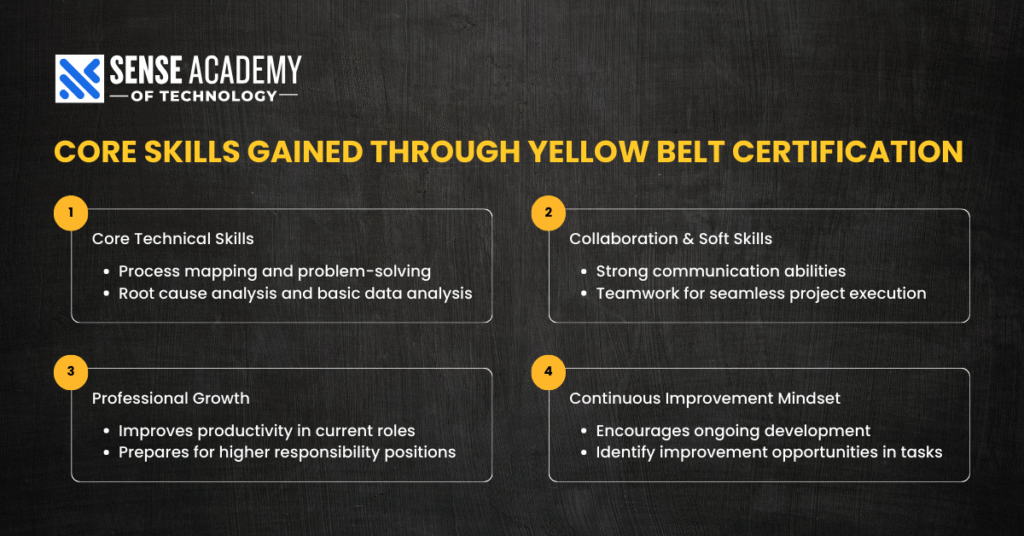
Learners who complete the Six Sigma Yellow Belt program gain useful abilities that are applicable in a variety of sectors. Process mapping, problem-solving, root cause analysis, and fundamental data analysis are a few of these. Additionally, Yellow Belts develop their communication and teamwork skills, which guarantee seamless project collaboration. These abilities assist people in becoming more productive in their current positions while getting them ready for future roles with more responsibility. More significantly, the Yellow Belt approach promotes ongoing development, enabling people to see areas for improvement in routine work. Certified Yellow Belts that have these fundamental abilities are a valuable addition to companies that prioritize quality and productivity.
Career Opportunities and Growth Pathways
Opportunities in a variety of industries, including manufacturing, healthcare, IT, logistics, and finance, are made possible by a Six Sigma Yellow Belt. Within enterprises, trained workers can participate in efficiency drives, minor projects, and improvement efforts. Additionally, the Yellow Belt serves as a springboard for career advancement, allowing students to eventually get Green Belt and Black Belt certifications. As they develop, they become mentors and project leaders rather than just project supporters. People who begin with Yellow Belt training put themselves on a road of ongoing improvement, where each new certification improves their leadership abilities and employment opportunities.
Industry Demand for Yellow Belt Professionals
Employees with Six Sigma Yellow Belt certification are in high demand by organizations worldwide due to their capacity to improve process efficiency. The importance of quality management and data-driven decision-making is increasing as industries change. Every level of business operations is improved by the practical understanding of improvement tools that Yellow Belts bring to the table. Participation of them in a team guarantees systematic thought processes and measurable results. Yellow Belt-certified professionals who can actively support company goals are valued by industries ranging from IT services to healthcare systems. Businesses that place a higher priority on customer happiness, cost reduction, and productivity are seeing an increase in this demand.
Salary Insights and Career Prospects

Obtaining a Six Sigma Yellow Belt certification offers measurable benefits for employees. Since certified professionals contribute value to firms, their salaries tend to be higher than those of their non-certified colleagues. The average pay in India is between ₹3 and 6 LPA, whereas the global average is between $50,000 and $65,000 per year. Beyond monetary benefits, a certification builds credibility in the job market and improves prospects for advancement. Long-term job progression is ensured by the Yellow Belt’s preparation for higher certifications like Green Belt and Black Belt, which include more responsibility, leadership roles, and higher pay.
How to prepare for Yellow Belt Certification?
Understanding the fundamentals of Six Sigma and how they are applied is necessary to get ready for a Six Sigma Yellow Belt certification. It is crucial to have knowledge of process mapping, data collection, and the DMAIC framework. Examining case studies facilitates the combined application of theory and practical application. Structured learning and direction are guaranteed by formal training from a trustworthy source. By completing tasks and scenarios, students improve their capacity for efficient problem analysis. Candidates who are dedicated to practice and ongoing education are better able to apply their knowledge right away in addition to passing the certification exam. The Yellow Belt will be a career asset from the start due to this preparation.
Achieve your Six Sigma Yellow Belt with SenseAcademy.
A specialized Six Sigma Yellow Belt program is offered by Sense Academy to assist students in beginning their path with assurance. Our curriculum explains Six Sigma principles in an easy-to-understand manner using real-world examples and applications. Participants acquire the knowledge and self-assurance necessary to make valuable contributions to improvement projects under the guidance of knowledgeable mentors. The course is designed to help people get ready for certification tests while emphasizing the development of useful skills for everyday tasks. The Yellow Belt becomes a stepping stone to leadership when students select Sense Academy, creating a clear path toward Green Belt, Black Belt, and beyond.
Conclusion
The Six Sigma Yellow Belt is the first step toward a profession defined by problem-solving, process efficiency, and continuous improvement. It is more than just an entry-level certification. Professionals can obtain a competitive advantage in any business by mastering the principles of Six Sigma and putting them to use in practical situations. The Yellow Belt offers the ideal place to start, regardless of the objective—career progression, personal development, or helping the company succeed. Learners can confidently advance toward Green Belt and Black Belt certifications with organized instruction and real-world experience, creating a solid foundation for long-term success.
FAQ’s
What is the duration required to finish Yellow Belt training?
Most Yellow Belt courses can be finished in a few days to two weeks, while the length of time varies depending on the program provider. The Yellow Belt is intended to be brief and beginner-friendly, focusing on fundamental ideas without going into excessive detail, in contrast to higher-level certificates. In order to make learning interesting and applicable, training frequently incorporates interactive modules, case studies, and hands-on activities. Participants can learn at their own speed due to the various online formats that many providers offer. All things considered, the Yellow Belt is an accessible certification that offers substantial value quickly due to its comparatively brief duration and targeted material.
Can a Six Sigma Yellow Belt help new hires in their career goals?
Yes. For students and recent graduates starting their jobs, Six Sigma Yellow Belt is quite helpful. It shows knowledge of quality management, process improvement, and systematic problem-solving—all of which are beneficial in fields including business services, manufacturing, IT, healthcare, and finance. Including this certification on a resume demonstrates a dedication to efficiency and professional growth in addition to technical expertise. It can help freshmen stand out in a job interview, improving employability and demonstrating to prospective employers that they can contribute to team-based improvement projects.
What types of positions are available to Six Sigma Yellow Belts?
As it is regarded as an entry-level qualification, a Six Sigma Yellow Belt can lead to a variety of employment prospects. Certified professionals can work as junior business analysts, project support workers, process improvement assistants, or quality analysts. The information acquired helps in understanding the foundations of process effectiveness and quality control, which are relevant to the banking, healthcare, IT, logistics, and service sectors. Yellow Belts give people a strong foundation and make them excellent team players, which frequently leads to quicker promotions or eligibility for higher Six Sigma responsibilities, even though they may not be qualified to lead large projects.